Erotica author, aka Elspeth Potter, on Writing from the Inside

Friday, April 30, 2010

Line Editing, Up Close and Personal

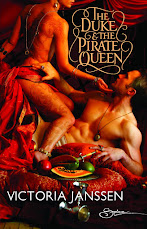
I spent a large portion of the month of April revising The Duke and the Pirate Queen; some of the revisions responded to my editor's comments, some responded to a workshop critique, and some came from my fevered brain.

I thought it would be interesting to share some of the line edits I made in the manuscript.

Original version:
Imena was far more devious than he'd predicted.
Revised version:
Imena was delightfully devious.

Original version:
...he could hear feet above, pattering on the main deck, distant shouting, the loud creaking of wood and rope and the snap of sail.
Revised version:
...he could hear feet pattering on the main deck above, distant shouting, the loud creaking of wood, the heavy hum of rope, and the snap of sail.

Original version:
Maxime stopped him from closing the door with a hand on Chetri's shoulder.
Revised version:
Maxime grasped Chetri's shoulder to stop him from closing the door.

Original version:
Gently, he dislodged Maxime's hand from his shoulder and stepped back.
Revised version:
Gently, he dislodged Maxime's hand and stepped back.

Original version:
She hadn't thought it was like her to brood, but in the cold dark hours of the morning, her past decisions surged and receded in her mind like surf.
Revised version:
In the cold dark hours of the morning, her past decisions surged and receded in her mind like surf.

Original version:
He turned his head and kissed in the vicinity of her ankle, dragging his mouth along her shin and nibbling with the edges of his teeth...He curled one hand around her calf and slowly slid upwards, seeking the top of her stocking.
Revised version:
He turned his head and kissed in the vicinity of her ankle, dragging his mouth upwards and nibbling with the edges of his teeth...He curled one hand around her calf and slowly slid up to her thigh, seeking the top of her stocking.

Original version:
Sunlight only occasionally filtered down through the trees, but when it did, the heat was trapped, and she felt it more powerfully with her clothing on. Sweat had begun to trickle down her back, mingling with tiny fragments of bark from her tree-climbing and the slightly sticky residue from The Knife's insect repelling balm.
Revised version:
Sunlight filtered down through the trees where the heat was trapped. She felt it more powerfully with her clothing on. Sweat had begun to trickle down her back, mingling with tiny fragments of bark from her tree-climbing and the sticky residue from The Knife's insect repelling balm.

Thursday, April 29, 2010

Dialogue Tricks

This post was originally written for Lauren Dane's Writerly Wednesday.

The first time I tried to write a novel (the one I started over and over and over again), I workshopped it with a very small group of friends. One wrote journalistic nonfiction, one was writing, essentially, memoir, and one was a published poet and writer of mainstream literary fiction. As you can imagine, I learned all sorts of useful things from these other writers, despite them being well outside my genre.

One of the things the poet said to me has stuck for all these years. She told me, and I paraphrase, that dialogue is one of the most essential methods of characterization. No two characters should speak alike.

There's an exercise one can do, which involves taking a piece of one's story and stripping out everything but the dialogue - all the names, all the tags, all the physical business, even the order of the sentences that provides clues - and then seeing if you can tell which character is saying what.

So in that first novel, I decided I would tackle this craft issue. I did it with what I considered to be a trick. Not that using tricks is bad. And eventually they start to sink into your skin and you no longer notice you're using them, and they're not really tricks any more.

My trick was simple: to assign each character one notable feature for their speech that would work with their personality. One character was in a position of power and confident about it. She tended to ramble when she spoke, assuming everyone would want to listen to her, and mostly spoke in statements. A second character was diffident and frightened. He was careful never to ask anyone a question for fear of appearing weak; he would often turn his questions into statements. A third character was speaking what was to her a foreign language, so her phrasing reflected that; also, since one of her main character traits was her anger at her situation, that too affected her speech patterns.

First character: "Here, put this on. It's freezing in here, we should have shut the window. Ziya collected clothes for you yesterday. And there're a couple of extra quilts in the closet if you need them."

Second character: "If I do not deviate, I am safe."

Third character: "You are giving up. Foolish. You are free. Not shut up in their labs."

I don't make those decisions so mechanically any more, but it's good to know that if I need to, I can go back to the trick.

Wednesday, April 28, 2010

What Does the Reader Need To Know?

Research is fun. Fun. Fun.

However, research for the writer's sake isn't always needed for the reader's sake. I get questions about this a lot.

The writer may need to know the mechanics of a specific task. For example, in 1901 in New Jersey, where does ice come from? How often does the ice man deliver? What does the heroine do with the ice after it's brought to her house? The reader, however, doesn't need every detail. The reader only needs what's relevant to the story.

If the key plot element is that the heroine is out of ice, the reader might need to know why (the ice man only delivers once every two weeks because the heroine's too poor to buy more, and the minister came to visit the day before the delivery). If the key plot element is needing ice to put on an injury, the reader might only need to know that the ice is kept in a box in the cellar, perhaps with some sawdust clinging to it to give the detail distinction.

Details are a good reason to research. When you're writing, it helps a lot to have details already in your mind, ready to slide into the story when needed: a woman in colonial America tested the temperature of her baking oven by how it felt against her hand; a dolphin's skin (and maybe that of a mermaid's tail) feels cool and rubbery; the smell of a fired musket lingers. The trick is not to include every detail.

It's usually better to explain less rather than more. Some things your reader will know already. To be really obvious, the reader knows that when it rains, things get wet. The writer doesn't need to tell them about cloud formation, weather prediction, and global warming. She only needs to let them know that Susie's clothing gets soaked and Joel offers to wrap her in his dry coat.

Tuesday, April 27, 2010

Top 5 Violent Hot Space Opera Babes

And now for something completely different.

Sometimes, you just need to watch some women blow things up.

Today I'm going to recommend some violent and also hot space opera babes. Traditionally, these are done as top fives, so that's what I did.

1. Princess Leia, Star Wars. Like, duh. I think she was the hottest in her bounty hunter costume in Return of the Jedi. Quote: "I don't know where you get your delusions, laser brain."

2. Aeryn Sun, Farscape. Not only hot, but tough. Much more a warrior than her eventual paramour, scientist John Crichton. She even gives birth in the middle of a firefight. Quote: "Shooting makes me feel better."

3. Dayna Mellanby, Blake's 7. A brilliant creator of weaponry as well as user of same. Also, hot. Quote: "Without danger, there's no pleasure."

4. Starbuck, Battlestar Galactica. The female one. Okay, so I haven't watched the later seasons yet. But in the earlier seasons, she is amazingly hot and also a total rake. I would buy her in any historical romance. Especially hot in her military undershirt. Quote: "Me in a dress is a once in a lifetime opportunity."

5. Ellen Ripley, Aliens. The second movie is the best. Hard, gritty, nonstop, and she makes the hard decisions. Especially hot when shooting evil aliens. Quote: "I say we take off and nuke the entire site from orbit. That's the only way to be sure."

Monday, April 26, 2010

"Nation, Race, and Empire," George Robb

British Culture and the First World War by George Robb.

Chapter One, "Nation, Race, and Empire"
During WWI, "Nationalism attempted to focus conflict outward--against a German foe inevitably constructed as a degenerate, barbaric 'throwback'...As successful as such ideas were in garnering support for the war effort, they created problems of their own since 'the nation,' as defined, clearly could not accommodate the diverse citizenry of Britain itself, let alone its vast, diverse Empire," p. 5.

"For contemporaries, the Great War represented not merely a national, but a 'racial' struggle. After all, since the nineteenth century, the concepts of 'nation' and 'race' had bled into each other. Victorian anthropologists and ethnographers had formulated racial hierarchies which placed Europeans on a higher plane of evolutionary development than Asians or Africans, but within Europe itself there was further jockeying for position...The English, Germans, Irish...were all understood to be separate races unto themselves, who possessed innate mental qualities...that were carried in the blood and revealed in the lineaments of the face," p. 7.

"Britain's military and imperial competition with Germany was bound up with post-Darwinian anxieties of racial degeneration and 'the survival of the fittest'," p. 7.

"Eugenics, the psuedo-science of heredity and selective breeding, had gained tremendous influence among British intellectuals in the generation before the war. As such it lent a spurious scientific authority to racial and class hierarchies and reinforced social Darwinist notions of an inevitable struggle between the races...it is not surprising that British society became saturated with Germanophobia," p. 8.

"...the line between anti-German sentiment and hatred of all foreigners was easily erased," p. 9.

Against attacks on foreigners: see Westminster Gazette and Manchester Guardian. Inciting attacks: John Bull, East London Observer. Sympathetic to rioters against foreigners: Evening News, Daily Mail.

British colonies
"Unequal, even racist, treatment of imperial soldiers who fought and died for a British victory increased colonized people's resentment of the Empire. Likewise, Britain's authoritarian rule over its colonies proved difficult to reconcile with the claim that it was defending democracy and the rights of small nations like Belgium. The Empire called upon subject peoples to defend the institutions of their subjugation. That so many of them were willing to do so highlights the complexities of imperial relationships," p. 11.

p. 12
Germany pre-war population 68 million, fielded 13 million troops
Britain pre-war population 45 million, fielded 6 million troops; plus 1 million Indians; 500,000 Canadians; 300,000 Australians; 100,000 New Zealanders; 80,000 [white] South Africans. "In addition, hundreds of thousands of Indians, Africans, Chinese, and West Indians served in military labor units outside their nations."

"Germany, however, delighted in pointing out that the defender of Belgium was the oppressor of Ireland and India," p. 13.

p. 15 Extensive propaganda to promote idea of loyal colonists.

Dominions: Canada, Australia, etc.. Dependencies: India, African colonies, West Indies.

"The white colonial elite also opposed blacks joining the Army, fearing it would give them aspirations above their station and lead to the erosion of racial boundaries," p. 21. There was a segregated West Indian regiment.

By 1915 some 138,000 Indian soldiers on Western front--by end of 1915, withdrawn from France and relocated to Middle East, pp 22-23.

Irish rebellion, the Easter Rising, occurred during WWI.

"...imperial subjects who worked and fought for British victory were unlikely to simply resume their old 'subject' status once the war was over," p. 29. Postwar riots involving immigrants in Britain.

"Of course, colonized peoples hardly needed to take part in the war to experience racism, but their wartime service proved crucial in convincing many of them that no amount of devotion to their British governors would grant them the racial status apparently necessary for full citizenship in the Empire. Perhaps the war's greatest tragedy was its tendency to promote an exclusive concept of 'Britishness', narrowly defined along ethnic and racial lines, rahter than an inclusive 'Britishness' based on a common citizenship of shared rights and responsibilities," p. 31.

Sunday, April 25, 2010

Geoffrey Dearmer, "The Turkish Trench Dog"

The Turkish Trench Dog

Night held me as I crawled and scrambled near
The Turkish lines. Above, the mocking stars
Silvered the curving parapet, and clear
Cloud-latticed beams o'erflecked the land with bars;
I, crouching, lay between
Tense-listening armies peering through the night,
Twin giants bound by tentacles unseen.
Here in dim-shadowed light
I saw him, as a sudden movement turned
His eyes towards me, glowing eyes that burned
A moment ere his snuffling muzzle found
My trail; and then as serpents mesmerise
He chained me with those unrelenting eyes,
That muscle-sliding rhythm, knit and bound
In spare-limbed symmetry, those perfect jaws
And soft-approaching pitter-patter paws.
Nearer and nearer like a wolf he crept--
That moment had my swift revolver leapt--
But terror seized me, terror born of shame
Brought flooding revelation. For he came
As one who offers comradeship deserved,
An open ally of the human race,
And sniffling at my prostrate form unnerved
He licked my face!

--Geoffrey Dearmer (1893-1996)

#
Today is ANZAC Day.

Saturday, April 24, 2010

Siegfried Sassoon, "Reconciliation"

Reconciliation

When you are standing at your hero's grave,
Or near some homeless village where he died,
Remember, through your heart's rekindling pride,
The German soldiers who were loyal and brave.

Men fought like brutes; and hideous things were done;
And you have nourished hatred, harsh and blind.
But in that Golgotha perhaps you'll find
The mothers of the men who killed your son.

--Siegfried Sassoon, November 1918

Friday, April 23, 2010

Researching WWI Uniforms - Linkgasm #5

Even if you don't have a library of World War One books, there are a number of useful websites that provide information about uniforms in that era. Here are some of the ones I've found useful.

The Sutlers Stores produces replica uniforms for museum display and docent use. Note the "grayback" shirt which I mentioned in The Moonlight Mistress.

Reenactor.net has a WWI section. It's not only useful for the information it provides, but as a gateway to making research contacts, if you should want to know what it's like to wear the uniforms. I love their Morsels of Authenticity, short articles about small details, like German underwear.

Military Headgear at Wilson History and Research Center.

I continue to recommend Osprey Publishing, particularly the "Men at Arms" series books, which feature detailed drawings of uniforms and equipment for a wide range of armies and time periods.

Digger History provides a long list of uniform photos and drawings from World War One and other periods, from all over the world. For example, infantry puttees.

For more idea-sparking material, you can search on WWI at Old Magazine Articles, if you're willing to spend a little time reading. For example, this Vanity Fair article on American uniforms for the well-dressed, October 1918. Their home page.

Thursday, April 22, 2010

You Make Your Own Luck

A fellow Romance Diva recently told the story of her first sale, which resulted from a series of events at an RWA Conference - not random events, not entirely. She had taken actions that led to those "random" events. The lesson I took away from her story was that it's better to make your own luck.

What do I mean by that? I mean that not every path (in this case, to publication) is the same. That seems self-evident, but really it's not. You have to keep your eyes open to see those other paths. I think it helps a lot if you're being yourself, and no one else, while you're doing that. You have to be open to opportunities; have hunches; do things that might not seem "normal" but that intrigue you anyway.

I won't give exact details since it isn't my story to tell. The Diva was writing in one genre, but attended a workshop for a different genre entirely. She participated, off-the-cuff, and discovered a new type of story she was interested in writing, and was able to pitch it to an editor whom she later encountered in another context, so she was able to strengthen her connection. Lesson one, she made her own luck by being at the workshop and being open to try something new. She followed up that connection by actually delivering a manuscript, and a synopsis of the next as well. Lesson two, she followed up, and continues to follow up to this day.

People talk a lot about luck in publishing, and I truly believe that luck is an element. But some luck, you can make for yourself.

I'd love to hear stories about unexpected connections and successes.

Wednesday, April 21, 2010

Elements Critique

A writer friend once commented that sometimes she needed a critique on plot and sometimes she needed a critique on character. And I think she was absolutely right.

Characters make plot, of course. And plot affects character, giving them things to do and things to which they must react. Plot and character have synergy. Sometimes, though, one of them is working better than the other.

A physical example of what I mean: you're lifting weights using a resistance machine. The weight for your left arm and the weight for your right arm move independently of each other. One of your arms is generally weaker than the other, so it takes concentration and skill to lift and lower both weights at the same speed.

If your plot is stronger, or your characters are stronger, the story can be out of balance or synch. An outside reader might be able to identify the problem for you: "The attacking herd of hippos is really awesome, but Ermengard never would have stood in front of Yvette; she's terrified of any animal larger than a cat. She would run instead, wouldn't she? Which means Yvette is the one who'd be more likely to take action." Or, "I love that The Great Og has to make a difficult decision here, but 'pea soup or lentil soup?' isn't as intense a choice as it could be."

Identifying the root of the problem can make it a lot easier to solve. Sometimes it's all in the angle you're using to look.

Related Post:
Backwards Outlining.

Tuesday, April 20, 2010

Writing Emotion

This post is more questions than answers.

I've been thinking about what makes some fiction so much more satisfying to read than other fiction, aside from factors such as story elements one loves, a well-constructed plot, and elegant prose style.

At bottom, I think emotional resonance is the most important element. Some characters, some stories, reach deeper inside me as a reader than others, and it isn't always the ones that are most original or best-written.

For me, characterization is probably the most important element in "feeling" a story. The elements of characterization to which I react, however, can be unpredictable. Something that works for me in one book might leave me cold in another. I hesitate to quantify what it is that hits me on an emotional level. If I identify those factors, will I be unable to enjoy them?

But I also need to understand how a writer might produce such effects on her readers.

Can an emotional effect be created technically? Is some emotional investment on the writer's part required, or even valuable, in accomplishing it? What causes the writer to become invested in a character? What causes the reader to become invested? Where does it happen? On the page, in the reader's mind, or some combination? Or does it happen in some liminal, subconscious way?

Can a writer who feels a deep emotional connection with her character transfer any of that attachment onto the page? Is a certain level of technical skill necessary to make the writer's feeling evident to the reader? Can a certain level of technical skill surmount lack of feeling on the writer's part? Can a writer who deliberately keeps his or her distance from the characters make them seem alive?

Can these questions even be answered? Is a moose going to run over my head?

Related Posts:
Learning Who Your Characters Are.
Caring About Your Characters – Or Not.
Kinesics in Fiction.

Monday, April 19, 2010

Unrealistic Dialogue

It's a pretty common observation that dialogue in a story is unrealistic.

There are all sorts of linguistic studies that relate to "real life" dialogue. Here's a pretty good introduction to sociolonguistics, for example. One of the things I learned from taking a linguistics seminar, many years ago, was how different speech is different from written communication, including letter-writing and even emails.

When we're writing, we can see what we've done. We are much less likely to include speech disfluencies (fillers) such as "you know," and "ummm," stuttering, broken sentences, incomplete sentences, and the like. Written, those things look like clutter. Spoken, however, they do serve several purposes.

The speaker might say "umm" because she's thinking of her next words, but doesn't want the person to whom she's speaking to interrupt. The "umm" might be a signal that the speaker still holds/wants to hold control of the conversation. Other fillers spoken by the listener, such as "mmm hmm," and similar, can serve the function of affirming to the speaker that the listener is actually listening, and following, or sympathizing/emphathizing. Stutters might indicate emotional intensity, whether the person stutters normally or not. Brief overview of speech disfluencies.

In relation to writing fiction, I think speech disfluencies can also serve various purposes. They can be used for characterization. The small interruptions can be used for rhythm's sake: to make a sentence flow in a different way (water over rocks instead of smooth flow); to break up long speeches so the reader doesn't get bored, and/or for a more naturalistic effect; to emphasize something. So long as these tricks aren't used as often as in actual speech, I think they can be very useful.

Sunday, April 18, 2010

Geoffrey Faber, "Home Service"

Home Service

"At least it wasn't your fault" I hear them console
When they come back, the few that will come back.
I feel those handshakes now. "Well, on the whole
You didn't miss much. I wish I had your knack
Of stopping out. You still can call your soul
Your own, at any rate. What a priceless slack
You've had, old chap. It must have been top-hole.
How's poetry? I bet you've written a stack."

What shall I say? That it's been damnable?
That all the time my soul was never my own?
That we've slaved hard at endless make-believe?
It isn't only actual war that's hell,
I'll say. It's spending youth and hope alone
Among pretences that have ceased to deceive.

--Geoffrey Faber (1889-1961)

Saturday, April 17, 2010

Wilfred Wilson Gibson, "Back"


Back

They ask me where I've been,
And what I've done and seen.
But what can I reply
Who know it wasn't I,
But someone just like me,
Who went across the sea
And with my head and hands
Killed men in foreign lands...
Though I must bear the blame,
Because he bore my name.

--Wilfred Wilson Gibson (1878-1962)

Friday, April 16, 2010

Slow Writers Anonymous

At the 2003 WisCon, there was a panel about "Slow Writers." I've been thinking about it again, and thought it would be a good thing to post in my blog.

This post is comprised of my distilled memories of the panel.

Everybody works differently, and everybody is right.

There are at least two kinds of slow writers: those who write a tiny bit consistently, and those who just don't write very often. Combinations of the two are also common.

Most writers want to increase their productivity.

There's a difference between writing and typing that can affect our perceptions of how fast we write. For example, some people plot out an entire story in their heads, spending many months reworking it, and then type the whole thing in a day. Some people count the thinking period as writing time, some do not. Some think on paper or computer screen, some don't.

A lot of the pressure to be a faster writer comes from having to market your work. Karen Fowler said (I paraphrase), "You have to finish your book before all the booksellers who've heard of you are dead."

Methods used by panelists and audience to try and speed their writing, some of which were used to make themselves write anything at all, were varied.

Some of what follows came from the Slow Writers panel, some from comments at the Living Room event I attended with Ellen Kushner and Delia Sherman.

One writer found the pressure of having a contract for her novel helped her to finish it; being accountable to someone else for pages produced helped many people, but not all. Others said finishing a book for which they already held a contract was more difficult, because they felt they were forcing themselves to go faster than normal.

Keeping a journal was mentioned by more than one person (for example, Peg Kerr) as a way to keep track not only of daily word count but of daily thoughts and feelings about the work; one can go back and see that one always gets depressed around page 200 of a manuscript.

Candas Dorsey said that she has often used old reviews or commentary on her work to give herself a boost when she felt discouraged about her progress.

Some can only write a story in chronological sequence, so when they are stuck, they must often retreat before they can go on. Others wrote various scenes and then connected them later, so if they got stuck, they could just move on to another scene.

A related strategy I myself have used, and that was described in the panel, is to always have more than one project going. If one project needs more thought, then move on to a second one, or a third.

A method to encourage productivity is setting a writing date with a friend, who may or may not also be writing. For that hour or however long, you must write, or at least stare at a page. Being responsible to another person for showing up is a good motivation; that method has worked for me. A variation used by Delia Sherman involves sending a certain number of pages to a friend on a regular basis (I think my variation on this is posting draft sections in my journal).

Some found deadlines from their critique group were helpful.

All of this was very useful, but the best thing about that panel was, I think, the validation!

Thursday, April 15, 2010

The Long and the Short of It

How do we decide a length for our stories?

I think a lot of it has to do with the stories themselves.

A friend of mine used to say that novels didn't adapt as well into feature films as short stories did, because a feature film was essentially a short story, about the Most Important Event in a person's life. If you adapt a whole novel into a feature film, you must perforce skip a lot, because novels are, in general, about the Most Important Time in a person's life. (Yes, those statements are full of generalizations, but they're still useful, I think.)

I brought up the feature film issue because to me, that explanation also tells us something about the sorts of stories that work better as shorts and those that work better as longs. Sure, some novels focus on one event, and some novels take place in very compressed time frames, but most of them follow the characters for a little while. I sometimes envision it this way: the novel as a piece of string and the short story as a little round thing in the palm of your hand. (I never said I envisioned it in a clever way....)

So I think it's important to know what your story is before you decide its length. Sometimes, one finds out what sort of story it is while writing it, and wastes a lot of time either trying to turn a short story idea into a novel, or to cram a novel idea into a short story.

Related Post:

Romance in Short.

Wednesday, April 14, 2010

Turn Your Writing Topsy-Turvy

In Jane Yolen's Take Joy: A Writer's Guide to Loving the Craft, she writes, "When we force ourselves to go topsy-turvy, we can see anew what is on the page," (p. 49).

She suggests taking a single chapter and re-reading the whole thing while changing the gender of the characters, or the point of view, or leaving out all the modifiers, or counting how many times you've used each sense for events you've related. All this is to help you see where you've repeated yourself, among other things.

This path had no colored lanterns, and the pristine white gravel gave way to hard-packed earth. Abruptly, their steps were silenced, and the evergreen hedges seemed to lean in on them, concealing them from view and softening the sounds of distant voices. (c. Victoria Janssen 2010): sight - 4; touch - 1; hearing - 2. Of course, I chose that selection because it had a lot of sense impressions. Hmmm.

Checking a few other places in my current manuscript, in a very unscientific way, my pattern continues of sight being the sense I refer to most often, followed by hearing, followed by smell or touch, so perhaps sampling is just as effective a way to do the exercise. I seem to use scent a lot when I need a quick, vivid impression, which makes sense to me, as I find some smells very evocative. Some examples: "opulent smell of roasting beans and honeyed pastries" versus the later "bread fried in lard and sour wine," along with a number of instances of distinctive scents associated with a particular character, either physical things (something they'd eaten or drunk) or associational (the person has a familiar personal scent which the pov character finds delicious).

I tried the gender switch exercise, and...in my writing, there's not much difference between how males and females speak and behave (aside from physical differences). Which doesn't surprise me much.

Yolen notes also that turning a prose paragraph into lines of poetry (just breaking the lines, not rhyming or anything) can help you identify where you've overwritten. Turning poetry into prose can help you see if you've been too cryptic.

Gulls swooped and
dove and
screamed.
Wading birds scampered
along the tide line,
stopping only to
stab their long beaks
into the wet sand
in search of food.
Behind the blindingly bright sand,
tall grasses waved
in the breeze, gradually merging into
low, darker green scrub and finally into
towering, densely leaved trees.
As she watched, a scarlet bird winged
from the trees to a rocky outcropping
that was white with guano.
(c. Victoria Janssen 2010)


(It's harder than it looks! I think this is a little flowery, but it's only one paragraph; I think it's okay to leave alone.)

I read Take Joy shortly after it came out, and had forgotten these very useful pieces of advice until I was browsing through my notes.

Tuesday, April 13, 2010

For Love or Money?

This post grew out of a discussion at one of my favorite blogs, Read React Review, specifically this post, "At What Point in the Writing Process Do Writers Think About What Will Sell?" Comments in italics are from Jessica, who wrote the original post. My comment was lengthy, and I've continued to think about the issues she raised.

I wonder where in the writing process writers think about this.

As you surmised, this is a difficult question. If you're a writer who reads in your genre (and most are, that's how they learn their genre), then you're steeped in it, and to some extent genre equals what sells to readers of that genre and vice-versa. And round and round and round she goes.... Plus, if you read in that genre, likely you're attracted to it anyway, on some deep level.

There is sometimes input from agent/editor/crit partners to try one thing or another. I haven't really had that yet, but it's common, and if I got such a suggestion, I would consider it seriously, to see if I could make that idea my own. I think it never hurts to consider outside advice, whether I take the advice or not. Sometimes others can see my writing more clearly than I can. I might be especially good at a particular type of story and have no idea that those stories are any better than anything else I've written. I might be good at something that's more salable than what I'm currently writing. Again, it's a tangled process of decision-making.

Here's an example of how I think this process works for me. I'd like to do a Victorian historical romance one day, and one reason is because mass market historical romance sells more than erotica and I'd like to make more money for a book. Market-wise, there seem to be a few more Victorian-set romances at the moment, so presumably they're selling.

My other reasons for that goal, though, are myriad: I love historical romance - it's the sub-genre I read most of these days - and I am always wishing for more Victorian-set books, and I love research. The Victorian period is a nice segue backwards from the Edwardian/WWI I've already used, so I'd be following my own interests. I already have some books, which I've been sporadically reading.

The thing is, if I wasn't intellectually and emotionally interested already, I don't think it would have occurred to me to try and write a Victorian historical romance in order to make more money. You're not guaranteed a sale, especially in a genre in which you've not previously sold. It's not worth it (to me) to put all that time and mental effort into a project unless I'm going to enjoy the heck out of it. For most novels, your hourly rate (counting writing, thinking, researching, editing, revising, proofing, marketing) is...minimal.

So far, this project consists of a few notes on hero and heroine, a few research books I've purchased but not yet read, and a substantial research wishlist (ahem, yes, I know my weaknesses!). The project is a carrot to me, a prize for when I've done the work for which I'm already contracted. That looms larger for me than any monetary motivation.

Does saleability function like a limiting set of pre-writing conditions, which, once determined, leave the writer free to forget about them, as long as she stays within their boundaries? Or is sales always one of the voices in a writer’s head as she types away?

Since I'm under contract right now, I tend to think more of my editor's opinions and the constraints of the line for which I write. Luckily for me, the Spice line does not seem to have many constraints. If I'm in doubt about something (real example: the male/male scenes in The Moonlight Mistress), I write what I want and let the editor decide. So far, both of my editors have been okay with my decisions. If the editor requested a change, I would probably make it, because after all, they're paying me for the book and they have more experience at what will sell. I do want people to buy my books and read them. If I felt strongly about, say, cutting a scene, I would bring it up with my editor and give her my opinion. But I suspect in most cases I would end up giving in, or at least compromising. Knowing myself, the editor likely sees the whole picture of the novel more clearly than I do.

I wonder if a never-published or early career writer has to pay more attention to what sells?

Since I support myself with an office job, this is less of a concern for me. I write for my own purposes first, money second. The money is icing, for me, lovely but not necessary every day. I know this about myself: I would write even if I wasn't being paid. I did it for years.

I know a number of people who support themselves through writing. It's difficult, and can be very unreliable as you wait to be paid, especially if you don't have a large output and are dependent on a limited number of contracts. I do not want to attempt that at my present level. I am more comfortable receiving a regular paycheck. Worrying about money is stressful and makes me less interested in writing. If I was selling amazing amounts of money with every book, that would be different, but I don't think that's likely to happen!

I'd love to hear opinions on this post.

Monday, April 12, 2010

History as Fantasy

In many ways, writing historical fiction is like writing fantasy. And reading historical fiction is like reading fantasy.

In one genre, you have to look up a lot of tiny details to make the reader accept that the world they're reading about is real/true. In the other genre, you have to make up a lot of details to make the reader accept that the world they're reading about is real/true. In both cases, those details have to be sprinkled into the text in ways that make sense for the story and don't distract the reader from the story, either. In both cases, the details have to hang together.

Both genres have similar reading protocols, as well. Fantasy readers can lose their suspension of disbelief if some part of the fantasy world doesn't make sense to them. This will vary according to how critically the reader reads, or what story elements are more or less important for them.

Historical readers can lose their suspension of disbelief when a historical detail in the story is inaccurate. This varies according to the reader's historical knowledge; for instance, if you know a period very well, you might catch slips that a less-informed reader might miss. And some readers can accept slips, because historical details or period-appropriate diction are less important to them than the story as a whole. Occasionally, the reader might lose their suspension of disbelief because, even though the historical details are accurate, they do not believe in its accuracy because they believe it contradicts something else they know - and that, too, can be a problem of how details are used and presented, part of creating believable architecture for an imaginary world.

Worldbuilding techniques cross-pollinate.

Related post:
Historical Detail in Fiction.

Sunday, April 11, 2010

Edward Shillito, "Hardness of Heart"

Hardness of Heart

In the first watch no death but made us mourn;
Now tearless eyes run down the daily roll,
Whose names are written in the book of death;
For sealed are now the springs of tears, as when
The tropic sun makes dry the torrent's course
After the rains. They are too many now
For mortal eyes to weep, and none can see
But God alone the Thing itself and live.
We look to seaward, and behold a cry!
To skyward, and they fall as stricken birds
On autumn fields; and earth cries out its toll,
From the Great River to the world's end--toll
Of dead, and maimed and lost; we dare not stay;
Tears are not endless and we have no more.

--Edward Shillito (1872-1948)

Saturday, April 10, 2010

Laurence Binyon, "Ypres"


Ypres

She was a city of patience; of proud name,
Dimmed by neglecting Time; of beauty and loss;
Of acquiescence in the creeping moss.
But on a sudden fierce destruction came
Tigerishly pouncing: thunderbolt and flame
Showered on her streets, to shatter them and toss
Her ancient towers to ashes. Riven across,
She rose, dead, into never-dying fame.
White against heavens of storm, a ghost, she is known
To the world's ends. The myriads of the brave
Sleep round her. Desolately glorified,
She, moon-like, draws her own far-moving tide
Of sorrow and memory; toward her, each alone,
Glide the dark dreams that seek an English grave.

--Laurence Binyon

Friday, April 9, 2010

Researching the 1970s - Gwynne Garfinkle Guest Post

Please welcome my guest, Gwynne Garfinkle!

#

Researching the Jo Book

I recently completed the second draft of a novel about a soap opera actress in mid-1970s New York City who's haunted by the ghost of her best friend who died protesting the Vietnam War. (The working title of the book is Some Misplaced Joan of Arc, but through the writing process I've mostly referred to it as "the Jo book.") I already knew a lot about soap operas and the '60s-'70s anti-war movement before I began writing, and I'm not sure I realized just how much research I would need to do.

I was ten years old in 1975, and in some respects I remember the time period very well. Yet it is in many ways a different world (not to mention the fact that I spent that time in Los Angeles, not New York). When I was writing a scene in which my protagonist Jo goes to see the newly released Dog Day Afternoon, I assumed she could go to her neighborhood movie house--but research revealed that the film only screened in one (now defunct) Manhattan movie theater when it first opened: Cinema 1. A friend of mine with access to newspaper archives even found me a New York Times ad for Dog Day Afternoon that included showtimes! Cinema Treasures, an online guide to classic movie theaters, provided a lot of info on Cinema 1.

A number of historical events are referenced in my novel, notably the arrest and trial of Patty Hearst. The book Patty's Got a Gun: Patricia Hearst in 1970s America and the documentary film Guerrilla - The Taking of Patty Hearst were excellent resources on the media's portrayal of the Hearst case. Again, my friend with access to newspaper archives helped me with specific news items, and I was amazed to learn that the New York Times headline for Patty Hearst's guilty verdict was: "MISS HEARST IS CONVICTED ON BANK ROBBERY CHARGES." I made frequent use of The Vanderbilt Television News Archive, which contains detailed descriptions of U.S. national network news broadcasts--including commercials--going back to 1968.
For information about the movement against the Vietnam War, as well as other political activism of the '60s-'70s, Cathy Wilkerson's Flying Close to the Sun: My Life and Times as a Weatherman and Dan Berger's Outlaws of America: The Weather Underground and the Politics of Solidarity were useful, as were the documentaries Rebels With a Cause and The Weather Underground.

As for the soap opera aspect of my novel, 1970s daytime dramas were produced in a very different way than they are today. Fortunately my friends Lara Parker (who played Angelique on Dark Shadows) and Rory Metcalf (who wrote for Ryan's Hope) answered my questions, as did Peter White, who played Linc on All My Children at just the time period of my novel. I also consulted biographies of soap opera actors and soap opera reference books, as well as Eight Years in Another World (a wonderful memoir by former Another World head writer Harding Lemay) and We Love Soaps, a great source of interviews and archival material.

A number of soap opera actresses have penned soap opera murder mysteries, from which I gleaned some behind-the-scenes information amid the dropping corpses. Books in this little subgenre include Louise Shaffer's All My Suspects and Eileen Davidson's Death in Daytime and Dial Emmy for Murder.

The other sources I used for Jo book research are too numerous to mention, but a few highlights include a 1976 NYC TV Guide, the 1975-76 Trans World Getaway Guide to NYC, the Mr. Pop Culture week by week archives, and a webpage of '70s toiletries advertisements, Stuck in the 70s. Sometimes a tiny, half-forgotten detail, like Love's Baby Soft or Gee, Your Hair Smells Terrific, can help bring a scene--and the time period of a novel--to life.


Gwynne Garfinkle lives in Los Angeles. Her fiction and poetry have appeared in Strange Horizons, Goblin Fruit, Aberrant Dreams, Space & Time, and the Clockwork Jungle Book issue of Shimmer. She is represented by Diana Fox of Fox Literary.

#

Thanks, Gwynne!

Thursday, April 8, 2010

WWI slang

Speaking Freely: A Guided Tour Of American English From Plymouth Rock To Silicon Valley. Stuart Berg Flexner and Anne H. Soukhanov, Oxford University Press, 1997.

p. 82 "The use of obscenity and scatology...increased greatly during World War I and became prolific during World War II. The use of the cursing modifier fucking, for damned, first reached epidemic proportions with British soldiers during World War I, by which time they were also using fuck arse (for a contemptible person, which American troops translated into fuck ass), fuck me gently (literally "don't take advantage of me too much, don't cheat me too blatantly"), fuck 'em all, and make a fuck up of ("bungle, ruin")."

p. 84 "Shithead is known from 1915...By 1918 S.O.L. was a common abbreviation for the older shit out of luck...In World War I the old rural term shithouse became a popular soldier's word for latrine, while shit alley was a particularly dangerous battlefield or position while shit pan alley was a military hospital (a pun on the 1914 Tin Pan Alley)."

p. 86 "Son of a bitch was used so often by World War I American soldiers as an expletive or intensive that Frenchmen called them "les sommobiches." The abbreviation S.O.B. also appeared during World War I."

p. 146
"Basket case, 1919, a quadruple amputee, originally British Army slang, later coming to mean mental, not physical, incapacity."

"Chow, which had been a slang word for food since 1856, became common in World War I, along with chowhound."

"Dud...By 1919 it had broadened to mean anything that did not meet expectations."

"By the end of the war...to goldbrick meant to shirk."

"Shell shock, 1915, originally a British coinage, found wide use by Americans even though the official military term was battle fatigue."

Wednesday, April 7, 2010

Making Time

"I have to find time to write."

I don't think that's true. You don't find time. You make time. You take it. You take it for yourself.

If you want to write, you have to choose time during which you will write.

You have to give things up in order to make time to write. If you don't already have writing time in your schedule, then what activity is filling your schedule? Your dayjob? Childcare? Housecleaning? Doing things for other people? Socializing? Regardless, there's a point where something has to give.

You can say it's easy for me. I don't have any children, I don't have a spouse who makes demands on my time. But, if I did have those people in my life, I would still need time for me. All of us need time for ourselves, to be ourselves. I am rarely more myself than when I'm writing. When that time is hard to locate, I get ruthless.

If I put off doing the laundry this week, will I still have enough clothes to wear to the dayjob? Will my friend forgive me if I can't go out to dinner with her this weekend? Will the volunteer effort fail completely for lack of my presence?

I choose. When I need to write, I make time to write.

Tuesday, April 6, 2010

Writing Marathons

I've learned three things from writing marathons:

1. I can trust my basic prose level to sound okay on first draft, without me paying too much attention to it as it flows out. I need to save my concentration for keeping the whole story in mind. Doing paper edits before the marathon helps a lot on thinking about the story's shape; so do the comments I get from my workshop on the partial. Making notes after those comments and edits, on specifically what I need to include before the novel's end, also helps a lot. The notes can be lather, rinse, repeat at each stage of the writing process.

2. Breaks are necessary for me, even in a marathon, even if the breaks are only standing up after an hour or so to put away part of a load of laundry. That's one kind of break. The other is finishing a large section, then taking a think-break and making notes on the next section, so I don't have to waste time flailing when I sit back down again to write. I can enforce my think-breaks by, for example, trapping myself downstairs waiting for my laundry to finish, with no entertainment but the notebook and pen.

3. I can write a lot in a short period if I need to, but never as much as I wish I could. I have to remind myself not to have wildly unrealistic expectations; it helps to know what I've managed to accomplish in the past.

Monday, April 5, 2010

Contraception in World War One

A History of Contraception: From Antiquity to the Present Day. Angus McLaren. Basil Blackwell Ltd., 1990.

p. 183-184 "Bentham declared in 1797 that population could be controlled not by a 'prohibitory act' or a 'dead letter' but by 'a sponge', indicating that a range of contraceptives was already known to the late eighteenth-century, middle-class readers of the Annals Of Agriculture. Carlile, in the first book published in England on birth control--Every Woman's Book: Or What Is Love (1826)--described the woman's use of a sponge, the man's employment of a baudruche or 'glove' and partial or complete withdrawal."

Marie Stopes published Married Love in 1918, which eventually sold over a million copies. She published Wise Parenthood later in 1918. She opened her clinic in 1921.

"In Europe [condoms] were still being made of animal skins and silk into the twentieth century; French propagandists provided information on how housewives could make condoms or baudruches from intenstines purchased at butcher shops...by the 1850s relatively cheap rubber condoms were available in the United States, A.M. Mauriceau offering to sell them at $5.00 a dozen."

19th century: condoms were too expensive for many people, and were prone to bursting. Also associated with disease and prostitution.

p. 184-185 "The invention of the diaphragm did represent a significant innovation in fertility control." 1882: "a soft rubber shield." Expensive, and had to be fitted by a physician. Douching after intercourse was recommended, though it was less effective than coitus interruptus.

Spermicides in the form of powders or jellies began to be developed at the turn of the century. Soluble quinine pessary in use in the 1880s. Women also made their own pessaries from cocoa butter or glycerine.

Latter decades of 19th century both useful and dubious contraceptives and abortifacients could be bought by mail or in barber shops, rubber goods stores, and pharmacies. Salesmen went door-to-door in some neighborhoods.

p. 217 Margaret Sanger founded the American Birth Control League in 1916. Opened her clinic in 1923.

p. 186 "nineteenth century Europeans' first means of limiting births was..simply abstaining from intercourse." Upper classes could have separate beds and/or bedrooms for husband and wife. People married later at end of 19th century. Rhythm method also followed by some, once idea of fertile periods discovered; unfortunately, the truth of a woman's cycle was not discovered for a long time. Extended nursing another method of limiting births.

p. 195 "Holy Mother we believe / Without sin thou didst conceive: / Holy Mother, so believing, / Let us sin without conceiving." (Alexandre Boutique)

Sunday, April 4, 2010

e.e. cummings, "the bigness of cannon "

the bigness of cannon
is skilful,

but i have seen
death's clever enormous voice
which hides in a fragility
of poppies....

i say that sometimes
on these long talkative animals
are laid fists of huger silence.

I have seen all the silence
full of vivid noiseless boys

at Roupy
i have seen
between barrages,

the night utter ripe unspeaking girls.

--e.e. cummings, Tulips & Chimneys (1922 Manuscript)

Saturday, April 3, 2010

Siegfried Sassoon, "The Hawthorn Tree"


The Hawthorn Tree

Not much to me is yonder lane
Where I go every day;
But when there's been a shower of rain
And hedge-birds whistle gay,
I know my lad that's out in France
With fearsome things to see
Would give his eyes for just one glance
At our white hawthorn tree.

. . . .

Not much to me is yonder lane
Where he so longs to tread:
But when there’s been a shower of rain
I think I'll never weep again
Until I've heard he's dead.

--Siegfried Sassoon

Friday, April 2, 2010

Saskia Walker - Guest Post

Please welcome my guest, Saskia Walker!

#

When I started out on my writing journey I used to fret about how the fantasy or paranormal elements of a story would mesh with the more everyday aspects. As writers we want our stories to flow seamlessly for the reader, and for them to accept what is way beyond the norm alongside the more rational elements.

This is a skill that my hostess has, in spades! In Victoria’s novel, The Duchess, Her Maid, The Groom and Their Lover, I found I accepted the more unusual aspects of the society she portrayed because the writing was so solid overall. For example, Victoria describes the Duchy palace, its furniture, art works, the costumes and surroundings, in such vivid detail that I readily accepted the more unconventional things that happen within this society. That is skilled world building.

A few years ago I took an online workshop by best-selling paranormal romance author Angela Knight. Angela was talking about how to give your paranormal characters life and make them leap off the page. When she had a question and answer session, I raised my concern about making the fantasy elements mesh, so that they are instantly acceptable to the reader. Her response was to research and write the real-world elements solidly. For example, if your hero is a police officer who is secretly a werewolf, it's his everyday police world you need to get right, and the reader will go with the rest because she/he will be so grounded in the character and the story.

That notion began to sink in for me, and I was able to look at the issue from a different viewpoint. It also meant I worried a bit less and focused on getting the groundwork right instead! I think I’m getting there, at least I hope so.

In my latest novel-length publication, Rampant, I had a lot of genre cross over to deal with, and it set up a number of “believability” challenges as a result. The story draws on the history of witchcraft in Scotland, and the very real persecution of those who were ousted as witches. The story is divided between a contemporary setting and a historical one, and in both settings several of the characters are secretly practising witchcraft. The rich paranormal folklore of Scotland and the history of persecution was something I was able to draw upon, as was my love of the natural world and the area I chose to set the story in, the East Neuk of Fife. What I had to mesh with that was my own world building, in particular, the magic.

To close, here’s an excerpt from a scene set in the historical world of Rampant. In this part of the book it was important to get the period and setting right, as well as the atmosphere of suspicion and persecution, in order to ground my story and give it weight. See what you think.

#
The master is leading me into the forest. He waylaid me as I was on my way to pick summer berries and ordered me to leave my basket and to follow him here instead. His mood is not good. With one hand locked around my wrist he drags me alongside him, his handsome mouth tightly closed.

“Ewan, what is it? Whatever is the matter?”

He does not reply.

We follow the path to the place where the coven meet, but the brethren are not here with us now. It is just the two of us, and the master is like a stranger to me. His head is bare, his hat who knows where, and his necktie is askew. His hair is uncombed, and he looks as if he has barely slept.

Beneath the trees the scent is high for it rained heavily in the night, an early summer storm, and whilst it is fresh down by the harbor, up here in the trees the musky smell of damp undergrowth fills the air. The ground is muddy and the path is damp and slippery beneath my boots, sending me skittering on the path.

He does not look back, does not seem to notice. Why is he bringing me here now, and why does he not speak? My heart beats hard in my chest, for I have a dreadful bad feeling about this.

“Speak with me,” I plead, “tell me what it is that you need. I promise I will do whatever you want, if only would look my way and speak to me.”

Still he does not answer. Instead, he drags me even faster across the ground, intent on some purpose known only to himself. I can barely keep up, my footsteps stumbling in his wake, my skirts snagging on brambles. Then I see our own place up ahead, the clearing where our coven meets. The circles of rocks mark the five points where we have set our fires, and the earth is burnt from our rituals.

He stops walking and pulls me up short in front of him, strong hands wrapped round my wrists. I have to stand on my toes and stretch, for he seems determined that I look him directly in the eye.

“Feel my ire,” he urges, “know it in your soul.”

I do feel it, I see it and I feel it, a churning vat of pain that he wishes to share with me. Betrayal, there is betrayal there too, amidst the rage in his expression.
“I see it, my beloved master, but I do not understand.”

“I thought you had more sense, Annabel McGraw. You are fickle, as unruly as a bored child. I scorn you for wasting precious time, for inviting trouble upon the coven by dallying with villagers when you should be honing your skills.” He kicks half burnt logs out of his way before he pushes me down in the ashes.

My body hits the ground, my spirit fast feeling what he wants me to know—humility, shame. He is showing me how he could break me. That I could be as easily fated by him as a woodland creature or a captured bird that he would sacrifice for some greater purpose.

Clumsily I sprawl, charred wood and rocky earth rough beneath my back, my left leg twisted beneath me. As his chosen woman amongst the coven, I can think of no greater shame that he could bestow upon me.

I try to rise up on my hands, my emotions unsteady and my thoughts running this way and that as I try to understand his actions. I resent him for this. “Why do you try to shame me this way?”

He drops to his knees beside me and shoves me to the ground with his hand hard against my chest. I cry out when the rocks and stones dig into my back. His eyes blaze and his lips are drawn back from his teeth. His anger is overwhelming. I feel it pumping violently from the hand he has splayed at the base of my throat where the skin is bare. His palm is so hot it makes me squirm for fear of being branded by him, a demon’s mark that I know he has the power to bestow. And yet it makes me lusty, too, for he is so handsome when his immense magical power burns in his eyes this way.

“You have been foolish, risking our secret, risking so much for a roll with an oaf of a fisherman.”

Was that it? That he is jealous of Irvine? I cannot fathom it at first, for he takes lovers where he chooses and it has not bothered him when I have done the same. But I am delighted, too, and I begin to see how I can turn this.

“Why do you do this?” he demands. “Is it not enough that together we could own all of the magic in Scotland?” He closes his fist around the air in front of my face, and I see the immense light that glows from within it.

I watch, secretly delighted by his actions. I am almost gleeful that his need for me has driven him to express himself in forbidden magical enchantments. He opens his fist and the light swirls out into the atmosphere, sparkling with colors, before darting away into the trees…

If you’d like to read another excerpt from Rampant, you can do so here.
#

Thanks, Saskia! (Also, I am blushing because you liked The Duchess, etc. Thank you so much!)

Thursday, April 1, 2010

Romance Series-Itis

Series-itis: there's entirely too much wordcount devoted to reminding us what happened to the hero when he was a minor character in a previous book, and setting up various other characters for their roles in future books, not to mention the obligatory mentions of previous romantic couples in the series.

I'm not sure why I like and continue to read series of linked books when what I really want is for the romantic couple of one book to go off to the jungle after their book is done so I don't have to find out that they're pregnant or that they just had twins or how happy they are now while in the middle of someone else's adventure. Their settled happiness is boring, and sucks all the lovely tension out of the current book.

And also, all the linked characters in such a series have to be Happy Together, or if they have any interesting disagreements, they must be resolved so we can eventually see them be Happy Together ("oh, he changed so much after his marriage to Julian's cousin's ward, you know the one who escaped France under the auspices of the Purple Pumpernickel--you mean Arthur is the Purple Pumpernickel? And he was in love with her? Oh, poor Arthur. Well, maybe he can find another wench, now that he's unexpectedly come into his title through that bizarre great-great-aunt accident.")

All that niceness gets a little wearing after a while. And if they're all so friendly, that means, again, that old characters have to take up space in each book that should belong to its hero and heroine. Series-itis sufferers often replace the quite useful unnamed flat character in order to shoehorn in someone from a previous or future book.

Judy Cuevas' Bliss and Dance use a better approach. The first book ends with the two brothers still not entirely settled in their relationship, and is resolved somewhat with very occasional letters in the second book. Brief, to the point, shows character change.

Related Post:
Ultra-Brother!