Harlequin Spice author, aka Elspeth Potter, on Writing from the Inside

Thursday, September 30, 2010

Heroine Doe

What do you look for in a romance heroine? Or the heroine of a space opera, or of a quest fantasy? What kind of heroine always makes you want to read further?

Does she need to be an orphan, or have a big happy family, or a mean and awful family?

Should her eyes be amethyst or only ever brown? Can she ever be conventionally beautiful?

Is she spunky? Angry? Sweet? Cynical? Kickass?

Can she physically defend herself? Does she have cool specialties?

Is she lonely? Vengeful? Weary? Angry?

What are the characteristics that, if you were given them in a blurb, would make you want that novel immediately?

What kind of heroine do you wish you were reading about right now?

Wednesday, September 29, 2010

Types of Masculinity

What does it mean, to be a man? To be masculine? What does it mean to be a man who is the hero of a romance novel?

Romance readers, including me, often talk about "alpha" or "beta" heroes as two generalized types. The alpha can be seen as a protector and/or a provider (rich in money or at least in skills) as well as a person with a need to dominate a relationship, or at least romantic situations; often the alpha is depicted as physically large and strong and far more attractive than the norm. The beta can be equated with the "nice guy" who might or might not be the most muscular or beautiful man the heroine has ever met.

What needs do those two basic types of heroes meet for readers? Are there possible alternative models of masculinity that could satisfy readers? How do market forces affect what's available? How do reader expectations affect what sells and what writers write? How do types of romance heroes mirror what society finds normative?

Do the alpha and beta models of masculinity allow for truly equal male/female relationships? And how do those roles intersect with female alpha and beta characters in fiction?

Tuesday, September 28, 2010

I Am My Own Muse

How's that for a pretentious title? But aren't all writers, really, their own muses? It's sort of in how you talk about it. Some personify, and talk about their "muse" as if it's something/someone outside of them. Others, like me, feel the "muse" is internal, ideas cooked up by the subconscious.

When I think about writing and inspiration, I go around and around in my opinions. (It's one thing on which every writer has an opinion, or opinions. Just ask us. Better yet, ask a herd of us all at once.)

I can't personify my urge to write and my inspirations. I know it's one way to feel you control those elements of writing, because if you can describe something, it's there. You can do things with it. You can "tell your muse to behave." All of these techniques are no doubt helpful at one time or another in the writing process.

At the same time, personifying means giving up control: my muse is not me. If my muse is not cooperating, it's not my fault. That can be good or bad. Sometimes, giving up control helps summon new depths to writing. Sometimes, you end up with confusing slop.

I'd rather, for the most part, have an element of control over my creative impulses. If I give in and write with little thought, I always, later, go over it with a critical eye. Maybe I'm just a control freak.

What about you?

Monday, September 27, 2010

Sunday, September 26, 2010

Wilfrid Wilson Gibson, "Retreat"

Retreat

Broken, bewildered by the long retreat
Across the stifling leagues of southern plain,
Across the scorching leagues of trampled grain,
Half-stunned, half-blinded, by the trudge of feet
And dusty smother of the August
He dreamt of flowers in an English lane,
Of hedgerow flowers glistening after rain--
All-heal and willow-herb and meadow-sweet.

All-heal and willow-herb and meadow-sweet--
The innocent names kept up a cool refrain--
All-heal and willow-herb and meadow-sweet,
Chiming and tinkling in his aching brain,
Until he babbled like a child again—
"All-heal and willow-herb and meadow-sweet."

--Wilfrid Wilson Gibson

Saturday, September 25, 2010

Edmund Blunden, "The Zonnebeke Road"

The Zonnebeke Road

Morning, if this late withered light can claim
Some kindred with that merry flame
Which the young day was wont to fling through space!
Agony stares from each grey face.
And yet the day is come; stand down! stand down!
Your hands unclasp from rifles while you can;
The frost has pierced them to the bended bone?
Why see old Stevens there, that iron man,
Melting the ice to shave his grotesque chin!
Go ask him,, shall we win?
I never likes this bay, some foolish fear
Caught me the first time that I came here;
That dugout fallen in awakes, perhaps
Some formless haunting of some corpse's chaps.
True, and wherever we have held the line,
There were such corners, seeming-saturnine
For no good cause.

Now where the Haymarket starts,
There is no place for soldiers with weak hearts;
The minenwerfers have it to the inch.
Look, how the snow-dust whisks along the road
Piteous and silly; the stones themselves must flinch
In this east wind; the low sky like a load
Hangs over, a dead-weight. But what a pain
Must gnaw where its clay cheek
Crushes the shell-chopped trees that fang the plain –
The ice-bound throat gulps out a gargoyle shriek.
That wretched wire before the village line
Rattles like rusty brambles on dead bine,
And there the daylight oozes into dun;
Black pillars, those are trees where roadways run
Even Ypres now would warm our souls; fond fool,
Our tour's but one night old, seven more to cool!
O screaming dumbness, o dull clashing death,
Shreds of dead grass and willows, homes and men,
Watch as you will, men clench their chattering teeth
And freeze you back with that one hope, disdain.

--Edmund Blunden

Friday, September 24, 2010

Prose Architecture and Experimentation

Back when I wrote a lot more short stories, I used to use each one as an opportunity for experimentation. This was partly because I feel experimentation is one of the best ways to improve your writing, and partly so I wouldn't get bored.

I experimented with different aspects of craft and character. I wrote a story in first-person. I wrote stories in second-person present tense. I tried out a light-hearted, slangy character voice; I tried a dark, despairing character voice; I tried sounding like a fairy tale and I tried sounding like myth. This post isn't really about whether I was successful or not. This post is more about what you need before you can experiment.

I looked back at some of those stories recently, and realized I wouldn't have been able to write them if I'd tried to do so when, say, I was in college. At that point, I just didn't have the chops. If you don't have the basics of prose down cold, and have not yet found your own voice, it's a lot harder to experiment. I think, once I started to sell those short experimental pieces, that I was ready for them, and it showed.

You can experiment as a beginner, and I think it's good to do so, but I think it's a lot harder to sell those experiments when you're still getting control of your prose. I think, to make a style experiment salable, it needs to have some substance besides the experimental aspect. You have to be a good enough writer to play with more than one aspect of craft at a time. You have to be able to keep the basic architecture of your building from falling down while you layer on the gargoyles and little curlicues.

At least, that's what I think right now. Doubtless a few years from now, after (hopefully) I've reached a new level in my writing, I'll have yet another opinion.

One of the most useful blog posts I've seen this week:
Why you should blog to build your writing career even if you don't think you need to by Justine Musk.

Thursday, September 23, 2010

LeGuin Festschrift

The Ursula LeGuin Festschrift, produced last year for her 80th birthday in an edition of one, will be coming out in print for the rest of us October 21, which happens to be Ursula LeGuin's 81st birthday.

You can pre-order (at a 25% discount) here.

Contributions include fiction from John Kessel, Andrea Hairston, Sheree Renee Thomas, Ama Patterson, and Pan Morigan, and essays and poetry from Richard Chwedyk, Debbie Notkin, Eileen Gunn, Kim Stanley Robinson, Lynn Alden Kendall, Brian Attebery, Gwyneth Jones, Vonda N. McIntyre, Karen Joy Fowler, MJ Hardman, Ellean Eades, Paul Preuss, Molly Gloss, Sarah LeFanu, Victoria McManus, Jed Hartman, Ellen Kushner, Pat Murphy, Nancy Kress, Jo Walton, Una McCormack, Julie Phillips, Patrick O'Leary, Eleanor Arnason, Deirdre Byrne, Suzette Haden Elgin, Lisa Tuttle, Judith Barrington, Nisi Shawl, Elisabeth Vonarburg, and Sandra Kasturi.

Wednesday, September 22, 2010

How Many Sex Scenes?

I recently read a contemporay romance and got into a brief discussion about the sex scenes.

I'd been perfectly comfortable with the amount of sex that was shown. The story focused on the two characters' relationship issues and issues that were them versus society; basically, Love Against the Odds. So far as sex went, they didn't really have any issues. They were physically compatible from the moment they met, and didn't have much trouble affirming their love physically. They were shown kissing, they were shown in bed with fades-to-black. It was clear they were getting along fine so far as sex was concerned. I was okay with not knowing explicitly what they were doing.

Another reader, who'd also liked the book, wanted at least one sex scene to be slightly more explicit, suggesting that the sex scenes ought to match the emotional intensity of the rest of the book, which is quite long and definitely weighted on the emotional side of the characters' relationship. I can see that, too. Balance isn't a bad thing.

However, I think it's also okay not to have explicit sex scenes in a romance novel. This book was marketed as a romance, not an erotic romance. Enough of the characters' erotic relationship was shown, I feel, for the reader to have the necessary information about it. I think it worked...but I can also see the other reader's point. The book could have been much richer had the couple's problems in their public lives been reflected in their private lives, with commentary in both directions.

However, perhaps the book I'm imagining would have been another book entirely. After all, it's not my book I thinking about. It's someone else's book. My book would have been different in many ways.

Have you read books that you thought didn't show enough sex? What made you feel that way?

Tuesday, September 21, 2010

The Best Part of Marketing

I'm not as dedicated to marketing my books as many advisors recommend, but I invest some effort because I can't resist the idea that I can find more readers. In particular, I hope to find readers who have never heard of me and who wouldn't necessarily search for a Harlequin Spice novel; readers who might not even know the Spice line exists. Specifically, I felt I had to market because I thought my books might appeal to a segment of speculative fiction readers, who wouldn't necessarily encounter Harlequin's marketing.

There is one thing I really like about marketing. It's when, unexpectedly, my little rubber balls thrown out into the aether bounce back. The best part is when I actually hear from someone, and they tell me they're interested in my novels because they saw one of my blog posts or follow me on Twitter or picked up one of the postcards or bookmarks I left in the Goody Room at RWA. It's empowering to realize something I've done has made a difference.

For instance, I recently received a message from someone who friended me on Facebook, based on one of those postcards. I met several people at the RWA Conference who knew me from Twitter.

When I hear back from someone, and they sound interested, I don't feel so much like I've been pelting the universe with me, me, me. Marketing feels more like a conversation to me, then. It feels less obtrusive. This realization helped me to make up my mind about revamping my website (I'm in the process of getting a quote on that, with the aim of having it fixed up in November sometime).

And I feel like I've accomplished something real.

Monday, September 20, 2010

Pirate Linkgasm

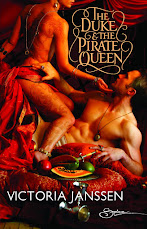
Before I wrote The Duke and the Pirate Queen, I didn't realize quite how many websites existed about pirates, especially pirates from the 1600s through around 1720, particularly in the Caribbean. That's the most common idea most people have of pirates, based on movies and novels such as Treasure Island.

Because I was writing a fantasy, I was able to use a mixture of ideas about "classic" pirates mingled with elements from nineteenth-century naval adventure novels and books about the pirates of Japan. In the course of all that, I found some fun websites.

The Port Royal Archives, which includes research papers, maps, and other documents.

The Queen Anne's Revenge Archaeological Project.

Maritime Museum of the Atlantic in Nova Scotia.

No Quarter Given, the website of a pirate magazine.

The New St. Augustine Pirate & Treasure Museum is set to open in November, 2010.

Sunday, September 19, 2010

Wilfred Wilson Gibson, "Breakfast"

Breakfast

We ate our breakfast lying on our backs,
Because the shells were screeching overhead.
I bet a rasher to a loaf of bread
That Hull United would beat Halifax
When Jimmy Strainthorpe played full-back instead
Of Billy Bradford. Ginger raised his head
And cursed, and took the bet; and dropt back dead.
We ate our breakfast lying on our backs,
Because the shells were screeching overhead.

--Wilfred Wilson Gibson

Saturday, September 18, 2010

Edward Thomas, "A Private"


A Private

This ploughman dead in battle slept out of doors
Many's a frozen night, and merrily
Answered staid drinkers, good bedmen, and all bores:
'At Mrs Greenland's Hawthorn Bush,' said he,
'I slept.' None knew which bush. Above the town,
Beyond 'The Drover', a hundred spot the down
In Wiltshire. And where now at last he sleeps
More sound in France--that, too, he secret keeps.

--Edward Thomas

Friday, September 17, 2010

Novelists, Inc. Guest Post - The Art of Letting Go


I'm a guest poster today at the Novelists, Inc. Blog on "The Art of Letting Go."

Please drop by and check it out!

And a Public Service Message:

"Call for Manuscripts - Journal of American Culture Special Issue:
Love and Romance in American Culture


Ideas of romantic love suffuse our lives and guide our emotional experiences and behaviors. Romance comes in various forms of romantic entertainment--books, films, music--which affect and form our socially constructed notions of love, gender and courtship. These constructs of love guide public and private behavior, create judgments of values in relationships and control rules of openness or closure in expression. There is a variety of ways that American culture has understood and practiced love and romance. This special issue of the Journal of American Culture will present a conversation about romantic love and its representations which explores love and romance as a theme in art, life and culture.

We are seeking manuscripts which discuss contemporary and historical representations of love and romance, consider ways of showing love and affection and explore socially constructed notions of love, gender and courtship. We are particularly interested in interdisciplinary approaches and analyses (literary, sociological, psychological, historical, anthropological, etc) involving any variety of topics (race, gender, class, homosexuality and queer studies, place, region, structure) which consider emotional values, attitudes and behaviors considered appropriate to love and romance

Submissions are welcome on topics which might include, but are not restricted to, issues and themes such as:

* romantic relationship events, rituals and ceremonies (weddings, holidays, festivals)
* dating and courtship rites (speed dating, personal ads)
* popular music and love songs
* depictions in the media and popular culture (e.g., film, television, literature, comics)
* romantic love in advertising, marketing, consumerism
* internet and cyberspace (blogs, texting, social networking)
* literature and fiction (genre romance, poetry, animé)
* amatory writings, love letters, courtship and self-help manuals
* types of relationships (marriage, gay and lesbian)
* feelings and emotions (intimacy, attachment, eroticism)
* types of love: platonic, philosophical, divine and spiritual romance
* neurobiology of love and biological attraction
* historical practices and traditions of and in romance
* regional and geographic pressures and influences (southern, Caribbean)
* material culture (valentines, foods, fashions)
* folklore and mythologies
* jokes and humor
* romantic love in political discourse (capitalism)
* psychological approaches toward romantic attraction
* emotional and sexual desire
* subcultures: age (seniors, adolescents), multi-ethnic, inter-racial

We suggest manuscript submissions of 4000-6000 words in length, double-spaced, in current MLA style. Send an e-mail attachment, in Microsoft Word or Rich Text Format. Due to virus and security concerns, we do not accept zipped or compressed files.

Manuscript deadline: 30 November 2011
Publication date: March 2013

Address inquiries to: JAC.Romance [at] gmail [dot] com

Maryan Wherry
Sarah S.G. Frantz
Darcy J. Martin"

Thursday, September 16, 2010

Writing the Senses

Have you ever done one of those writing exercises to make you think more about using all your senses in your writing?

I've at least tried some, but I get bored pretty quickly with exercises, so instead I steal the ideas and try to use them in my normal writing.

One thing I feel strongly is that it's not necessary to use every sense in every bit of description. For some writers that may be a feature; they may be intending to have the reader dwell in the world they're creating, be immersed in it, but for most purposes, I think it's okay to only give outlines. Vivid outlines, but outlines.

My theory is that reading is a collaborative process. Every reader brings something different to the book. The writer can denote, but everything they write also connotes. Every reader will gain different connotations from the same denotations. (Here's a great concise explantion.) A writer can connote a lot with very few words.

I like that, because I admire concise prose. I would much rather read a scene in which one sense is vivid and connotative, and emblematic of the pov character, than one in which several senses have been laboriously included just for the sake of using a lot of different senses.

Wednesday, September 15, 2010

The Nerd Heroine - Louisa Edwards Guest Post

Please welcome my guest, Louisa Edwards!

#

When I sat down to write Just One Taste, I had only one thought in mind: I want to write about a nerd. And not a nerdy hero, either--I wanted my heroine to be a first class, grade A+++, Wookie-loving, Magic card-carrying friend of Buffy. If you know what I mean, and I think you do.

Oh, I had justifications. I wanted to play with themes of emotional intelligence (the ability to read people and respond to their emotions) vs. book smarts, and I wanted to explore the hard science of food chemistry in relation to the more mysterious realm of culinary aphrodisiacs.

But mostly? I wanted to write a heroine who, while certainly better at chemistry than I'll ever be, loves the same things I do. I wanted to write a woman who is smarter than everyone else in any given room, and doesn't try to hide it. And I wanted to pair her with that most romantic creature of all--a hero who adores her exactly the way she is.

Dr. Rosemary Wilkins has a wide ranging interest in science fiction shows and books, from Battlestar Galactica to Jim Butcher’s Dresden Files. I admit it, I needed zero special research to know what an authentic nerd would enjoy! All of her references come straight out of my everyday vocabulary--and I only wish I had her awesome t-shirt collection.

So here is my list of Top Five Nerd Essentials (and I hope by now it’s obvious that I use the term "nerd" with a deep, abiding affection and pride):

1. Star Wars--the original episodes 4, 5, 6. Accept no substitutes! These were the first sci-fi movies I ever saw (my mother actually recorded the historic moment of my exposure to The Empire Strikes Back in my baby book), and they left an indelible mark on my young psyche.

2. Buffy the Vampire Slayer—-the TV show. I had never before been so obsessed with anything as I was with that series. The dialogue, the wit, the--omg, characters! I mean, Spike, alone. . .I think I’ve watched the entire series, all seven seasons, straight through at least 10 times. Even writing this blog post is making me want to watch it again. Don’t judge me. And while we’re on Joss Whedon--Firefly. Nathan Fillion in tight pants. ‘Nuff said.

3. The Lord of the Rings--books and movies. My mother read The Hobbit out loud to me when I was about 8, and I couldn’t wait to read the rest of the books. No world has ever captured my imagination as completely.

4. Terminator--the first one. Okay, I like them all, but the first one remains one of the best romances on film. I’m serious! Sarah Connor and Kyle Reese are a couple for the ages.

5. Battlestar Galactica--the new TV series. Talk about obsessed! It’s utterly engrossing, fabulously complex, the characters are crazy flawed and fascinating, and I have the biggest girl crush ever on Starbuck.

So that’s my list! Who’s on your list? Comment for a chance to win a signed copy of Just One Taste and some signature Recipe for Love swag.

#

Thanks, Louisa! Ummm...so, who would win if Spike and Darth Vader and a Terminator and Gandalf all had a fight? Me, I think Wolverine would show up and beat them all. Because of his healing ability and general meanness, you see.

Tuesday, September 14, 2010

How To Rest Your Writer Brain

After I learned the novel I'd been working on had been cancelled, I went with friends to Longwood Gardens and spent a gorgeous, idyllic afternoon and evening there.


Monday, September 13, 2010

Steampunk Themes

What are some common themes of steampunk fiction? (If you have suggestions, please comment!)

I'm thinking along these lines:

Punk, to me, at base means rebellion against an establishment.

Because steampunk is influenced by the culture of Victorian England, I also feel there needs to be some kind of commentary on colonialism and empires, and on class divides. Looking at these issues through a "real world" lens is an important part of this.

Technology versus nature also ought to be in there, though on the whole I feel technology in steampunk is usually favorable so long as it's wielded by the good guys. Tech might be temporarily bad, but I don't think I've ever seen anything steampunk in which technology ended up being abolished. If it causes bad effects, they're usually outweighed by the good.

Thoughts? Comments?

Here's an interesting related post at the Age of Steam blog: The Darker Side of Steampunk.

Sunday, September 12, 2010

Wilfrid Wilson Gibson, "The Joke"


The Joke

He'd even have his joke
While we were sitting tight,
And so he needs must poke
His silly head in sight
To whisper some new jest
Chortling. But as he spoke
A rifle cracked--
And now God knows when I shall hear the rest!

--Wilfrid Wilson Gibson

Saturday, September 11, 2010

Edward Thomas, "Gone, Gone Again"

Gone, Gone Again

Gone, gone again,
May, June, July,
And August gone,
Again gone by,

Not memorable
Save that I saw them go,
As past the empty quays
The rivers flow.

And now again,
In the harvest rain,
The Blenheim oranges
Fall grubby from the trees

As when I was young
And when the lost one was here
And when the war began
To turn young men to dung.

Look at the old house,
Outmoded, dignified,
Dark and untenanted,
With grass growing instead

Of the footsteps of life,
The friendliness, the strife;
In its beds have lain
Youth. love, age, and pain:

I am something like that;
Only I am not dead,
Still breathing and interested
In the house that is not dark:--

I am something like that:
Not one pane to reflect the sun,
For the schoolboys to throw at--
They have broken every one.

--Edward Thomas

Friday, September 10, 2010

Be vewy quiet; I'm adding geeky detail!

There are various schools of thought about adding historical detail to fiction. Sometimes you want more detail, sometimes less; partly, that depends on the book's genre. For example, in a Tom Clancy novel such as The Hunt for Red October, there is a lot--a lot--of detail about nuclear submarines. But if you're reading that book, it's likely that one of the reasons is because of all that lovely, crunchy technical detail.

Historical novels need historical detail. But how about historical erotica? How much historical detail does there need to be?

drumroll

There should be as much historical detail as I want. And the geekier, the better.

If the details I choose to include are not what the reader expects, that's all to the good. Those details will stick better for being unusual. (cf. the picture of a horse wearing a gas mask.) And because they stick in the reader's mind, they're more useful for building up a picture of the time period, and also a picture that feels deeper and richer than whatever generalized ideas the reader might have had. (What does World War One mean to you? Trenches? There was fighting in the mountains of Italy, as well. And in Africa.) I feel anything that brings the reader more completely into the story is a good thing.

The more geeky the detail, the more that detail feels specific. Specificity is important; the more specific, the more vivid and immediate the image becomes in the reader's mind. You can say, there were birds. Or you can say, she remembered the poignant cries of bitterns and the song of reed-warblers, and the occasional slow dignified silent soaring of a heron towards the far horizon.

The more specific the detail, the less often you have to use detail, and the more subtly you can use it.

Related Posts:

Historical Detail in Fiction.

Research: When to Stop.

Thursday, September 9, 2010

Steampunk Research Books

I've begun basic research on the history of the American West for a western steampunk novel. My book isn't going to be a historical, but I want it to be informed by history and in dialogue with history.

I chose Frontiers: A Short History of the American West as my basic overview book.

The Encyclopedia of North American Indians: Native American History, Culture, and Life From Paleo-Indians to the Present was recommended by Debbie Reese at her blog, American Indians in Children's Literature.

Peoples of Color in the American West is a textbook and has a lot of material that's more modern than I need, but I think it will be a good guide to further resources.

I chose The Comanche Empire partly just because I wanted to read it!

Check out its awesome reviews. "In the eighteenth and early nineteenth centuries, at the high tide of imperial struggles in North America, an indigenous empire rose to dominate the fiercely contested lands of the American Southwest, the southern Great Plains, and northern Mexico. This powerful empire, built by the Comanche Indians, eclipsed its various European rivals in military prowess, political prestige, economic power, commercial reach, and cultural influence. Yet, until now, the Comanche empire has gone unrecognized in historical accounts." So far, this book is just as incredibly cool as it sounds.

If you've got any more book suggestions for me, please comment!

Wednesday, September 8, 2010

RWA 2011 in NYC - things to think about

If you've never been to New York City before, and if you're debating whether or not to attend the 2011 RWA National Conference in New York City, here are some of my thoughts.

Because the city is a major destination, it might be easier to find cheap flights; if you live in an area where it's possible, it's also very easy to take the train to Penn Station, which is close to the conference hotel. The hotel, the Marriott Marquis, is expensive, but unlike in some other cities, you won't be limited to the onsite hotel restaurants; Midtown is crowded with restaurants with a wide range of prices. (Though take note, the Marquis has a cool revolving rooftop restaurant!)

Depending on your tourism desires, sightseeing can also be very cheap in New York, if you're willing to walk and take the subway. (Cabs are reasonable as well, but sometimes hard to come by during rush hour or in certain neighborhoods). There are myriad guides and helpful websites to tourism in the city. And the people-watching can't be beaten.

Plus, you can also attend the International Association for the Study of Popular Romance Conference, which is piggybacked on RWA. One trip, two conferences!

Tuesday, September 7, 2010

Alas, No Steampunk.

I'm sorry to announce that the steampunk Western novel for Spice has been cancelled.

I'm not sure if I will continue to work on that project for another possible publisher, or work on something else entirely, since I have a number of different projects clamoring for my attention.

I'll post when I've decided.

Recent Steampunk

Today, some recent steampunk novels.

Caveat - I have not yet read any of these books, but I've been collecting them for my To Be Read pile. Suggestions welcome if you have them! Please refrain from spoilers in the comments.

The Native Star by M.K. Hobson. "The year is 1876. In the small Sierra Nevada settlement of Lost Pine, the town witch, Emily Edwards, is being run out of business by an influx of mail-order patent magics."

The Alchemy of Stone by Ekaterina Sedia. "Mattie, an intelligent automaton skilled in the use of alchemy, finds herself caught in the middle of a conflict between gargoyles, the Mechanics, and the Alchemists. With the old order quickly giving way to the new, Mattie discovers powerful and dangerous secrets - secrets that can completely alter the balance of power in the city of Ayona. This doesn't sit well with Loharri, the Mechanic who created Mattie and still has the key to her heart - literally."

Boneshaker and Dreadnought by Cherie Priest feature a Civil War-era alternate Seattle.

Leviathan and Behemoth, Young Adult novels by Scott Westerfeld, are set in a universe where WWI went differently. "This global conflict is between the Clankers, who put their faith in machines, and the Darwinists, whose technology is based on the development of new species."

Clockwork Angel by Cassandra Clare is linked to a present-day Young Adult series by this author.

Monday, September 6, 2010

Selling the Unusual Setting

This post was originally written for The Naughty Girls Next Door. Since then, I learned from author Michelle Styles in a comment to that post that Harlequin Mills & Boon has been seeking out unusual historicals, publishing one a month - so there's a market right there! You can check out her comment in more detail here.

Here's the original post:

And now for something completely different.

A different time period, I mean. Since I've been following author blogs and forums related to the romance genre, again and again I've encountered the notion that unusual historical settings are a hard sell. There's less talk about erotica; it's a smaller part of the market and doesn't always overlap; it's its own niche, and I think sometimes there's more freedom of setting in erotica than in romance.

My post today is not to be taken as the be-all and end-all on this issue. Mostly, I'm just thinking through strategies that might work. Keep in mind that my World War One novel, The Moonlight Mistress, is erotica, which as I mentioned might be an easier market for unusual settings. I have not yet sold a romance novel, so anything I say about the romance market is gleaned from observation and conversation.

Here are my thoughts on unusual settings in Romance. In romance, historical usually means Regency (often extended beyond the actual Regency period), Victorian, pre-Regency Georgian, a few French Revolution novels, and...not a lot else. There's a sprinkling of European medievals, usually set in England, and a few Westerns (America, usually post-Civil War), and a few others. I'm sure I'm missing some, and of course the periods and locations of the few books not set in eighteenth through nineteenth century England will vary according to market pressures and other things which I am not going to go into, since that isn't really the topic of this post.

My topic (finally she gets to it!) is how to make the most of the "unusual" period you've chosen. Bear in mind that none of my suggestions are guaranteed to work. If they were, I'd be selling them on television. My suggestions are just intended to help you to think about ways of selling your novel in a more holistic way than simply throwing it against the wall of Regencies over and over again.

If you're starting from scratch, I think the first step is to write the book. No, really. You're much better off trying to pitch something that's a little different if you already have it in hand. The editor can then see what the whole novel is like, and you can impress them with how cool it is and how relevant to today's world.

A simultaneous step is to know the market. Even if there's nothing else exactly like your novel out there, still be prepared to give examples of already-published similar works, not just books but movies or television series or comics, to give an idea of your novel's potential market viability. "Similar" might mean similar themes, a similar basic plot, or a similar sub-genre. For instance, you could compare your romantic suspense novel set during the Russian Revolution to one set during the French Revolution that features similar situations. Or compare your novel to a series of historical mysteries set during the Russian Revolution or some other revolution. Or even to a novel with similar themes set during the breakup of the Soviet Union. Knowing that there are similiarities will not only help you pitch the novel, if needed, but also will give you ideas as to how you might shape it to make it more marketable. (Yes, I said write to market! Those aren't naughty words!)

Third, you can set up a niche market for yourself. Perhaps you could write some short stories set in the time period and location of your choice. After you've sold a few of those, you can use them to demonstrate the possible viability of a longer project. At the least, you've made a little money from the short stories!

I'd welcome further ideas on this topic, so feel free to comment or tell me that my ideas would never work.

Friday, September 3, 2010

Pirate Promotion

A friend of mine is providing me with quite a lot of her own time and energy to help me with promotion for The Duke & The Pirate Queen. Recently, we met for lunch a couple of times and she, who once worked as a journalist, walked me through an outline she'd created, of things she saw as easy opportunities for book promotion.

She has a lot more confidence in me than I do. Which is one of the lovely things about friends. We even discussed how certain things might not actually do any good, but I might do them anyway to make me feel like I was doing something to help the book.

Aside from organizing the book's launch party, which she has done for both of the previous books as well, she's writing up a press kit for me to include on my revamped website, which will hopefully go live in November; she looked at the press kits on some romance author sites, and we're going to base it on those patterns, with the addition of a sort of FAQ interview (she's done a lot of interviews in the past). I'm hoping that will make my biography page more interesting. She left it to me to arrange for an author photograph, which I've never actually had; I contacted a professional friend, and potentially I'll be able to get that taken care of before the book comes out.

The rest of her ideas, we're going to work on after the new year. Right now, the website is my priority, and I'll be working with someone in October on that.

It feels good to have a priority. It all feels more manageable when I have a tidy list.

Thursday, September 2, 2010

Promotional Bookmarks

Back when I first posted about promotional bookmarks and postcards for The Duke & The Pirate Queen, I promised to give an update on how it was going. So, here's how it's going...sort of.

I don't actually know yet how it's going. I carried quantities of the bookmarks and postcards with me to the RWA conference and to Readercon, and left them on the freebie tables. People took them. I had taken far too many to RWA, so I collected most of the leftovers before I left on Saturday, but a lot of them had still been taken. Several people told me they'd seen my materials and said how beautiful they were, so that was nice feedback.

Once home, I began preparing packages of the promotional materials to send out. First on the list was a bookstore owner who'd actually contacted me via email, and second was a librarian I'd met at RWA; she'd given me her card. I also collected a few librarian and bookstore addresses from various sources on the internet: people who'd recently won awards from RWA, and specialty bookstores who looked as if they might be interested. In the weeks since, I've been gradually preparing envelopes for each of those venues, including a handwritten letter in each one, to ask if they are willing to distribute the materials for me. I'm not expecting to hear back from them; I just hope they have a use for what I've sent. Ziplock bags inside of flat-rate priority mail envelopes have been my method so far.

The best thing, so far, about having these materials is that I, well, have them. I was able to give them to people I talked to, and in some cases the bookmark seemed more appropriate than giving them my business card. The materials also served as conversation pieces, as anything with my covers tends to do, thanks to Harlequin.

I will be bringing more bookmarks and postcards to the fall conventions I plan to attend. If you'd like me to send some to you, or to your local bookstore or library, please comment or email me.

If I get any additional feedback, I'll report!

Wednesday, September 1, 2010

Genre is the Highest Form of Literature

I think genre fiction is the highest form of literature. I really do. If "highest" means most important to humanity. How's that for a sweeping claim? Romance, fantasy, mystery, and science fiction. Those are the highest literature out there.

For one thing, look at history. Today, Dickens is "literature." To contemporary readers, he was cheap "escapist" entertainment. So longevity, I feel, is an important part of what makes a particular novel "important" or "not important", "commercial" or "literary"...and I'm already tired of all the air quotes. So I'll stop with those.

Fiction is literature. Literature is fiction. Stories are stories are stories. Every reader reads every story in a different way, through a different lens, for a different purpose. I can get just as much out of a good mystery as I can out of a novel about some white man's midlife crisis; more, actually, since I'll finish the mystery. The really important stories don't wear out. I think genre is the best vehicle for those stories. Coming of Age/Finding Yourself; Fighting Evil; Finding Family--those are all a lot more fun when they happen in the midst of aliens attacking, or hot sex, or trying to solve a murder.

Genre has longevity. People like genre, and they read a lot of it, so it tends to linger; think of all those copies of Harry Potter novels piled up like walls. Think of that pulp adventure story people like so much, The Iliad (which is also kind of epic fantasy), or that fantasy romance that people still talk about, starring Rama and Sita. Genre, it sticks around. The sub-genres shift, but the basics are still there.

Genre tends to use its tropes to address issues of current social concern, even if it does so thematically and not directly; for that reason, it will always be an important historical resource. You can learn an awful lot about, say, gender roles in the 1940s just from reading golden age private detective novels. Or how people feel about technological watersheds from reading science fiction. Fiction can be a useful comparison to nonfiction of a given time period. Add to that the entertainment aspect of genre, and you get more longevity.

Plus, genre tells the stories that are important to us, under the surface. Genre fiction is today's mythology. Genre fiction is in us, not just from the books themselves but also from television, movies, games...certain stories are there, and we use them to make shapes out of our lives. We swim in a genre sea. Certain stories will continue to be there, forever and ever, amen.

And that's why I think genre is the highest form of literature.