One thing I haven't been able to do for the last couple of years is write short stories.
I haven't lost the ability, or at least I don't think I have. It's that I'm spending all my time writing novels. Which, since those are under contract, is only right. But I still miss short stories. Especially that they're short.
One of the most fun things, for me, about writing short stories was the beginnings. Unless I was on a deadline for a particular piece, I would often write several stories at once, and have several more in the very early stages. If I was stuck on one, I'd open a new file and start writing another, usually with very little idea where that story was going to go. Sometimes those beginnings linger, untouched, for months or even years, before I figure out where I want them to go. And then, it's magic.
Can you tell I really, really enjoy openings? There's so much possibility there, so many ways the story can go afterwards.
Here are a few openings that are still lingering on my laptop:
#
"Golem"
Elama studied the Torah with her father, and she went to a man in the desert and studied magic, but she finally settled on electrical engineering because she could make good money doing that and make a good marriage because her classes would be full of eligible candidates. By the time she was near graduation, though, she'd finally realized that she was a lesbian and wasn't going to marry a man any time soon, if ever. It depended on what her parents thought about having a grandchild come out of a turkey baster.
#
"My Grandmother's Love Letters"
I stayed with you while Mom went to buy you Cheerios and some Kentucky Fried for our lunch together. You told me how your mama said not to marry Carter, that he was nothing but bad news. You told me Carter used to come see you hungover, but he brought you candy, and then the two of you would go out honky-tonking. He would drive his shiny Studebaker that he bought with his payoff from the merchant marine and you would dance the night away with him and his friends. You came home so late your sister would've had to do the supper dishes, but you'd pay her with the candy, since you didn't want to get fat. Carter didn't like fat women.
#
"Free Cell"
We played a game, Octavius and I, but while we played he didn't know it was a game.
The most important toy involved was a tape recorder.
"You're weak," Octavius said into the microphone. His eyes flickered with candle flame reflections, gold and diamond-wet shine and vampire red. The candlelight shimmered on his chocolate-dark hair and seemed to spark off the tip of a fang.
#
I'd love to get back to these some day!
Related post: Novel Beginnings: On Opening Sentences.
Sunday, January 31, 2010
Saturday, January 30, 2010
Good versus Talented
"Good writing is clear. Talented writing is energetic. Good writing avoids errors. Talented writing makes things happen in the reader's mind---vividly, forcefully..."
— Samuel R. Delany, About Writing: Seven Essays, Four Letters, & Five Interviews
— Samuel R. Delany, About Writing: Seven Essays, Four Letters, & Five Interviews
Friday, January 29, 2010
Finishing the Manuscript

When is a novel manuscript finished?
1. When you reach the desired wordcount? (Well, yes, sort of.)
2. When the deadline arrives? (It had better be finished by then.)
3. Finished? What is this finished of which you speak? (Not a good idea.)
4. When opening the computer file means you end up on the floor with no memory of what's just occurred? (I think this means you've been working on it too long.)
5. When you've sent the manuscript off to your editor? (Why, yes. I think so.)
Then you're done. At least until she sends you your revisions. But that will be months from now.
Then, take a brief moment to appreciate the words you taught to your spellchecker. In my case (word processor was updated, so it was worse than usual): arse; ballocks; catamite; dildo; kohl; mangosteens; vambraces.
Now, it's time to start the next project.
Related post:
The Art of Letting Go.
Thursday, January 28, 2010
Choosing Your Paranormal Creature
This post was originally written for the Paranormal Romantics blog.
Vampire or werewolf? Demon or elf? Ghost or ghoul or unknown creature that goes bump in the night?
One of the earliest decisions most writers make when conceptualizing a novel is the characters. When writing a paranormal, one of the most important aspects of character is, obviously, the paranormal element. It's easy enough to choose if you only like vampires, or have a contract to write a story about a demon, or just got a nifty new book about pookas. But sometimes you have no guidelines, or want to try something new. How do you decide?

I thought about these issues when I first wrote the synopsis for THE MOONLIGHT MISTRESS. I already knew the historical period was going to be World War One, and the setting Europe. There had to be room in the story for an erotic-romantic plot as well as historical and paranormal details. Because that time period isn't often used in romance or erotica, the setting would require a fair amount of detail. Thus, I decided not to stretch too far with my paranormal element. I chose werewolves.
Choosing a paranormal creature that's popular in fiction doesn't mean one can't use that creature creatively. I researched werewolves, thought about the werewolf fantasies and romances I'd read, and decided what I had liked and disliked, and what I thought would be useful for my particular story. I added my own interpretation to the mythology in ways that would underline my story's themes, and made their nature an integral part of the plot. Werewolves worked perfectly in my story as a symbol of nature. They could be in conflict with new technologies emerging as a result of the war.
That, I think, is the most important part of choosing a creature: seamlessly blending the myth with character and plot and theme, to make it intriguing and surprising to the reader.
I could have chosen other approaches. Many non-European people participated in World War One, and I could have chosen a creature from African or Indian mythology who had traveled with the soldiers, but that choice would have required mythological and cultural research in addition to the historical research, and I had a limited period in which to complete the novel. I'd still like to try that for a future story, though, and have been keeping an eye out for resource material. In that case, I could perhaps explore themes related to colonialism.
For another example, I might have used vampires as a way of underlining the vast loss of life. Ghost stories were common in World War One, and would have easily tied in to themes such as grief, mourning, and memory. The possibilities are endless, and worth thinking through before you begin to write.
Wednesday, January 27, 2010
Today Through History
One of the reasons I most enjoy researching and writing about World War One is that it's a time period rich in issues that interest me. For instance, in Great Britain during World War One, woman suffrage was still being debated, and sex between two men was still a crime. These gender issues are still relevant today, as women continue to fight for true equality in education and employment, and the right to marry a same-sex partner (or even to have such a partner) remains illegal in many countries.
Though The Moonlight Mistress is an erotic novel, and a pulpish adventure, I still wanted to offer views of these issues seen through different lenses and incorporate them into the novel's themes, especially through my use of werewolves as a paranormal element.

For those reasons, I included several female characters who were on the edges of acceptability in 1914. One is a professional chemist. Unable to obtain an academic position because of her gender, she works as a nurse, stealing research time when she can find it. Another, unable to make a living at her chosen trade, disguises herself as a man. Both of these women, in taking on roles separate from what their society expects of them, mirror the shapechanging werewolves in the story.
Another subplot follows a gay man who longs for acceptance even more than he longs for love. He cannot know if the object of his affections shares his preferences, and if he reveals himself the consequences could be dire. Another character is slowly coming to terms with the idea that he is bisexual. It's easy for the present-day reader to identify him as such, but the character doesn't know if anyone else like him exists in the world. They, too, can be seen as mirrors of the werewolves: hiding in plain sight, always looking for others of their kind.
The werewolves can stand in for any outsider, whether societal outcast or stranger in a strange land. The reader, hopefully, will find her own resonance in the story.
Science fiction, often ostensibly about the future, offers a truer picture of the writer's world. Historical fiction, too, doesn't represent the past as it happened, but the past as we, looking back, see it. The view is distorted by our past experiences and opinions, not only those we consciously notice but those that are so ingrained that we don't even think to question them.
As a writer I can't control, for the most part, what interpretations readers bring to my stories. Too much happens in the gaps between what I've written and the reader's personal experiences. The two mingle together and give a different picture to each reader. The best I can do is offer the reader as much fodder for the subconscious as I can possibly manage.
Tuesday, January 26, 2010
Costumes at Arisia 2010

Here are a few photos I took at Arisia, of people in costume. Arisia has a large and popular masquerade (part exhibition, part contest, often including choreographed routines or skits as part of the presentations). Dedicated costumers might have an entry in the masquerade in addition to hall costume or costumes which they wear throughout the convention.
The steampunk costume to the right featured a pair of mechanical stilts, which you can just see at the bottom of the photo.

I really loved this look on the left, which I'd classify as steampunk rather than historical. Their jaunty hats make the outfits, I feel. The curling ribbon! The red rose! The green in her hat that matches the green in her corset!
Note his coat seems to be pirate-inspired with the beautiful embroidered cuffs and lapels; also note the little round sunglasses he's wearing at his throat, and the detail around the neckline of her dress.

I chose this last photo to show that not all the costumes were steampunk! The Joker competed in the masquerade and, while merely walking around, did a great job of projecting an air of crazed menace with his accurate recreation of the character's walk from the movie.
The two of them were getting stopped for photos every few feet as they tried to cross the hotel's narrow lobby. At one point, I saw The Joker riding up in one of the glass elevators, together with a pitch-perfect Batman.
Monday, January 25, 2010
Steampunk Leather

Professor Maelstromme's Steam Laboratory and Brute Force Studios were at Arisia this year, and kindly allowed me to take a few photos for my blog. Here's the Good Professor's blog: "Incorporating mildly dangerous artifacts into compelling jewelry". I didn't get a chance to meet her in person.

Behold the steam-robot. This picture is my favorite because it looks like he's lecturing the little robot. In bonus sepia for bonus steampunk-aura!
You can see hints of some of the corsetry for sale in the background.

This costume is even more amazingly intricate in person than in a photo. Those patterns are actually cutouts, the gold leather cut away to show the red leather beneath.
I was very tempted by some leather chokers and especially by a forearm-guard/communications device that was decorated with vintage typewriter keys, but I restrained myself. (I did visit it twice, though!) You can have a look at it here.
Being a science fiction fan means never having to say, "Where would I wear that?"
Sunday, January 24, 2010
Siegfried Sassoon, "At Carnoy"
At Carnoy
Down in the hollow there's the whole Brigade
Camped in four groups: through twilight falling slow
I hear a sound of mouth-organs, ill-played,
And murmur of voices, gruff, confused, and low.
Crouched among thistle-tufts I've watched the glow
Of a blurred orange sunset flare and fade;
And I'm content. To-morrow we must go
To take some cursèd Wood ... O world God made!
July 3rd, 1916
--Siegfried Sassoon, The Old Huntsman and Other Poems, 1918
Saturday, January 23, 2010
Siegfried Sassoon, "Arms and the Man"
Arms and the Man
Young Croesus went to pay his call
On Colonel Sawbones, Caxton Hall:
And, though his wound was healed and mended,
He hoped he'd get his leave extended.
The waiting-room was dark and bare.
He eyed a neat-framed notice there
Above the fireplace hung to show
Disabled heroes where to go
For arms and legs; with scale of price,
And words of dignified advice
How officers could get them free.
Elbow or shoulder, hip or knee,
Two arms, two legs, though all were lost,
They'd be restored him free of cost.
Then a Girl Guide looked to say,
'Will Captain Croesus come this way?'
--Siegfried Sassoon, The Old Huntsman and Other Poems, 1918
Friday, January 22, 2010
Google Grab - Tom Purdom, Guest Blogger
Please welcome my guest, science fiction author and music critic Tom Purdom.
#
On January 20th I attended the New York workshop on the Google settlement conducted by the National Writers Union and the American Society of Journalists and Authors. The main speakers were Lynn Chu, agent and lawyer, who opposes the agreement; Paul Aiken of the Authors Guild, who spoke in support; and a law professor, James Grimmelman who has been offering nonpartisan commentary. Michael Swanwick attended also and we both took notes.
CONCLUSION
Michael had already opted out of the agreement and I just did. It has many virtues but for me the crux of the matter came down to this: the settlement would give Google a dominant, smothering position in electronic publication.
Aiken defended the settlement on the grounds that it would open up a new market for writers, since it would make out of print books available online. But this is already happening, and it's been going on for some time. Fictionwise and Amazon's Kindle are just two examples. And it's happening in the old fashioned way. Publishers are starting companies and programs and signing contracts with individual writers. Under the settlement, Google could become the website everybody turns to and we would all be forced to accept the collective terms they can enforce under the settlement.
If you opt in to the settlement, in addition, you are essentially signing a contract without knowing what the terms are. The settlement may be changed as litigation proceeds.
Even as it stands, it's a complicated agreement most of us can't take the time to study. In the discussion, Lynn Chu kept focusing on the implications of the agreement and Aiken kept insisting her fears were groundless. But to me she was simply noting that the language of the agreement may have implications we don't understand.
THE PRO SIDE
Aiken outlined the positives of the agreement.
To summarize: It applies only to out of print books. Readers may view snippets for free, but never more than twenty percent of content. Readers must pay for a complete online view and the author sets the price. Libraries will have one machine on which complete texts may be viewed and printed copies, made at that one machine, will be sold on a per page basis. Institutions, such as universities, may purchase subscriptions to the service, one year at a time. Google will receive thirty-seven percent of all money collected and the rest will be distributed to the authors, through a Book Rights Registry which will administer the system and subtract its administrative expenses from the author's share.
Authors may withdraw their works at any time. They may withdraw selected works or all their works.
That doesn't look too bad. But I think it will be hard for writers to opt out if it becomes the single site most readers turn to. And that limits our ability to negotiate.
OPT IN VS. OPT OUT
The settlement grew out of a suit the Authors Guild brought against Google, as a class action. The Guild has settled on behalf of all members of the class. If you want to opt out of the settlement, you must take a positive action. If you don't do anything at all, you have opted in.
Many people object to the settlement on that ground alone. Normally, people reprint our works because we have granted permission. They have to get a positive response.
There seems to be some question about the legality of opt out. It apparently stretches the concept of the class action suit.
OPTING OUT
Go to www.googlebooksettlement.com/. Click Opt Out. Fill in the form.
When Michael tried to opt out awhile back, you had to list every individual title, with all sorts of information. You no longer have to do that. Don't be fooled by the optional request for titles. It really is optional.
Lynn Chu recommends that you put the following statement in the box calling for titles:
This opt out request should be considered to apply to all works whatsoever of mine that appear in any and all books either by myself or by others.
The opt out deadline is January 28, 2010.
STANDING
The settlement will be appealed if the court approves it. But writers and organizations can only appeal if they have opted in. People who've opted out can't appeal because they have no standing. That appears to be one of the peculiarities of class action law.
Michael Copabianca sat on the panel as immediate past president of Science Fiction and Fantasy Writers of America. Some writers and organizations, he said, have deliberately left one or two works in the settlement so they can appeal.
Individual writers can do the same but one of the antis noted that a judge might feel you favored the settlement if you had opted in. They suggested instead that you send your opinion to the court or sign the petition Ursula K. Le Guin is circulating.
AN UNANSWERED QUESTION
The Authors Guild has defended the settlement on the grounds that the courts might decide in favor of Google if the case went to trial. That would mean the court would decide that Google was engaging in fair use, and anyone who wanted to could do what Google is doing.
I have assumed the Guild sued Google over Google's right to publish copyrighted material on the Web. But some remarks made at the workshop indicated the Guild suit deals with Google's scanning of the works. I didn't have a chance to ask anyone about this. But if it's true, it seems to me it undercuts one of the Guild's main arguments.
James Grimmelman said he feels the court will probably find that scanning is fair use. But he also feels Google's publications plans would definitely be seen as a violation of copyright. And it's publication that most writers are concerned with.
A PERSONAL NOTE
In the early 80s, a magazine publisher added a third page to its contract granting the publisher all electronic rights. Damon Knight issued a letter urging writers not to sign that page (which could be signed separately) and the publishers soon withdrew it.
As Damon said at the time, no one knew what those rights were worth. The publisher was obviously hoping writers would sign just to avoid conflict. Why risk losing a sale over a hypothetical possibility?
We didn't sign and the publisher eventually withdrew the third page. The publisher's act set off alarm bells in the mind of all writers familiar with the history of science fiction.
From 1926 until 1950, science fiction was a pulp magazine genre. Writers like Clarke, Bradbury, and Asimov assumed their stories would be printed in the magazines and never reprinted. There were no science fiction book lines and no science fiction anthologies. Many writers signed away those rights in "all rights" magazine contracts. Why not? Nobody was ever going to reprint their stuff.
Then the book publishers discovered there was a market for science fiction and started printing anthologies and novels taken from the pulp period. And writers had to live with the contracts they had signed in another era.
It seems to me Google is making a Grab, to use one of Damon's terms.
I hope you will find this useful. I've done my best to make it accurate.
#
Thanks, Tom!
If anyone's wondering, I opted out.
#
On January 20th I attended the New York workshop on the Google settlement conducted by the National Writers Union and the American Society of Journalists and Authors. The main speakers were Lynn Chu, agent and lawyer, who opposes the agreement; Paul Aiken of the Authors Guild, who spoke in support; and a law professor, James Grimmelman who has been offering nonpartisan commentary. Michael Swanwick attended also and we both took notes.
CONCLUSION
Michael had already opted out of the agreement and I just did. It has many virtues but for me the crux of the matter came down to this: the settlement would give Google a dominant, smothering position in electronic publication.
Aiken defended the settlement on the grounds that it would open up a new market for writers, since it would make out of print books available online. But this is already happening, and it's been going on for some time. Fictionwise and Amazon's Kindle are just two examples. And it's happening in the old fashioned way. Publishers are starting companies and programs and signing contracts with individual writers. Under the settlement, Google could become the website everybody turns to and we would all be forced to accept the collective terms they can enforce under the settlement.
If you opt in to the settlement, in addition, you are essentially signing a contract without knowing what the terms are. The settlement may be changed as litigation proceeds.
Even as it stands, it's a complicated agreement most of us can't take the time to study. In the discussion, Lynn Chu kept focusing on the implications of the agreement and Aiken kept insisting her fears were groundless. But to me she was simply noting that the language of the agreement may have implications we don't understand.
THE PRO SIDE
Aiken outlined the positives of the agreement.
To summarize: It applies only to out of print books. Readers may view snippets for free, but never more than twenty percent of content. Readers must pay for a complete online view and the author sets the price. Libraries will have one machine on which complete texts may be viewed and printed copies, made at that one machine, will be sold on a per page basis. Institutions, such as universities, may purchase subscriptions to the service, one year at a time. Google will receive thirty-seven percent of all money collected and the rest will be distributed to the authors, through a Book Rights Registry which will administer the system and subtract its administrative expenses from the author's share.
Authors may withdraw their works at any time. They may withdraw selected works or all their works.
That doesn't look too bad. But I think it will be hard for writers to opt out if it becomes the single site most readers turn to. And that limits our ability to negotiate.
OPT IN VS. OPT OUT
The settlement grew out of a suit the Authors Guild brought against Google, as a class action. The Guild has settled on behalf of all members of the class. If you want to opt out of the settlement, you must take a positive action. If you don't do anything at all, you have opted in.
Many people object to the settlement on that ground alone. Normally, people reprint our works because we have granted permission. They have to get a positive response.
There seems to be some question about the legality of opt out. It apparently stretches the concept of the class action suit.
OPTING OUT
Go to www.googlebooksettlement.com/. Click Opt Out. Fill in the form.
When Michael tried to opt out awhile back, you had to list every individual title, with all sorts of information. You no longer have to do that. Don't be fooled by the optional request for titles. It really is optional.
Lynn Chu recommends that you put the following statement in the box calling for titles:
This opt out request should be considered to apply to all works whatsoever of mine that appear in any and all books either by myself or by others.
The opt out deadline is January 28, 2010.
STANDING
The settlement will be appealed if the court approves it. But writers and organizations can only appeal if they have opted in. People who've opted out can't appeal because they have no standing. That appears to be one of the peculiarities of class action law.
Michael Copabianca sat on the panel as immediate past president of Science Fiction and Fantasy Writers of America. Some writers and organizations, he said, have deliberately left one or two works in the settlement so they can appeal.
Individual writers can do the same but one of the antis noted that a judge might feel you favored the settlement if you had opted in. They suggested instead that you send your opinion to the court or sign the petition Ursula K. Le Guin is circulating.
AN UNANSWERED QUESTION
The Authors Guild has defended the settlement on the grounds that the courts might decide in favor of Google if the case went to trial. That would mean the court would decide that Google was engaging in fair use, and anyone who wanted to could do what Google is doing.
I have assumed the Guild sued Google over Google's right to publish copyrighted material on the Web. But some remarks made at the workshop indicated the Guild suit deals with Google's scanning of the works. I didn't have a chance to ask anyone about this. But if it's true, it seems to me it undercuts one of the Guild's main arguments.
James Grimmelman said he feels the court will probably find that scanning is fair use. But he also feels Google's publications plans would definitely be seen as a violation of copyright. And it's publication that most writers are concerned with.
A PERSONAL NOTE
In the early 80s, a magazine publisher added a third page to its contract granting the publisher all electronic rights. Damon Knight issued a letter urging writers not to sign that page (which could be signed separately) and the publishers soon withdrew it.
As Damon said at the time, no one knew what those rights were worth. The publisher was obviously hoping writers would sign just to avoid conflict. Why risk losing a sale over a hypothetical possibility?
We didn't sign and the publisher eventually withdrew the third page. The publisher's act set off alarm bells in the mind of all writers familiar with the history of science fiction.
From 1926 until 1950, science fiction was a pulp magazine genre. Writers like Clarke, Bradbury, and Asimov assumed their stories would be printed in the magazines and never reprinted. There were no science fiction book lines and no science fiction anthologies. Many writers signed away those rights in "all rights" magazine contracts. Why not? Nobody was ever going to reprint their stuff.
Then the book publishers discovered there was a market for science fiction and started printing anthologies and novels taken from the pulp period. And writers had to live with the contracts they had signed in another era.
It seems to me Google is making a Grab, to use one of Damon's terms.
I hope you will find this useful. I've done my best to make it accurate.
#
Thanks, Tom!
If anyone's wondering, I opted out.
Thursday, January 21, 2010
Steampunk Bronze
I recently attended Arisia, a Boston-area science fiction/fantasy/a lof of other things conference. I got permission from Butch Honeck, one of my favorite sculptors in bronze, to post some photos from his dealer room at the convention.

Here's a steampunk-style pistol he built (bonus sepia for bonus steampunk-ness!). You can't tell from the photo, but it has moving parts - gears and a chain - that make warm whirring sounds. He let me play with it without making me buy it. He had several pistols with different features.

Here he is checking out one of his larger sculptures, also with moving parts. Note the magnifying lenses attached to his glasses. He sells those for steampunk afficionadoes, but apparently they're quite functional.

Pretty dragons. I've enjoyed looking at his work for years, and own three bronze turtles from his line of miniature animals as well as a pair of earrings.

A wider view of one of his display tables at Arisia. The woman in costume is examining pocket watches, some of them of the "real" hand-wound type.
Learn more here.
Wednesday, January 20, 2010
Grasping Tentacles of DOOOOOM
There's a stage in writing when I'm too busy writing, and thinking about the specifics of the novel, to think about the task of writing itself.
Of course I am thinking about writing. I have to be, because I'm doing it. By the time I reach the point I'm describing, I'm writing intuitively, and I feel like I'm using so many skills at once that I can't describe what I'm doing except with bizarre hand-waving gestures and metaphors that don't make sense to anyone but me. *wiggles finger while waving left hand and looking expectant*

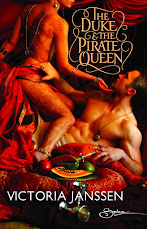
So, I have about ten days left to finish the manuscript of The Duke and The Pirate Queen. The draft is essentially complete, but I'm still doing a lot of things at once. I'm adding new material and editing old material to accomodate new ideas and doing some last-minute research and line editing and worrying. (I always worry, even if there's nothing in particular to worry about.) I'm also not-doing: not reading as much, not paying attention to my surroundings, not seeing my friends with my usual frequency.
When I get to this point in a novel, I may know what I'm doing, but I still grasp for help with every limb, and will occasionally, at weak moments, return to favorite books on writing in the hope of...I'm not sure. It's too late in the process for most of the advice to be useful. It might be reassurance I'm seeking; the knowledge that there are other writers in the world, and they had deadlines, and they figured out their manuscript issues in the end.
That, or it's like gorging on carbohydrates - the more you eat, the more you want.
Today, I think I've moved beyond the grasping stage. I have a complete draft. It's by no means perfect, but I can see the whole shape, and thus it's a lot easier to see what else I need to add. I've printed out a copy, because sometimes I can see - or maybe I really mean think about - the novel better when I can look at it in a different way than before.
Besides all that, having a complete draft is a great balm to the spirit.
Tuesday, January 19, 2010
Purposeful, Habitual, and Gratuitous
"As early as 1959 or '60, I'd noticed that there was something terribly wrong with the female characters in most novels I was reading. Most of the writers (men and women) tended to conceive of their male characters as combinations of purposeful actions, habitual actions, and gratuitous actions. A female character, in contrast, would be all gratuitous action if it was a "good woman," with no purposes and no habits; if it was a "bad woman," she would be all purpose, with no gratuitous actions and no habits. This seemed silly. Very early on I tried to think about women characters in terms of all three -- actions purposeful, habitual, and gratuitous."
--Samuel Delany, interviewed in Alive and Writing: Interviews with American Authors of the 1980s,by Larry McCaffery and Sinda Gregory, University of Illinois Press, 1987, pp. 99-100.
--Samuel Delany, interviewed in Alive and Writing: Interviews with American Authors of the 1980s,by Larry McCaffery and Sinda Gregory, University of Illinois Press, 1987, pp. 99-100.
Monday, January 18, 2010
Fun with Plot Generators
Recently, I went on an internet search for plot generators. Here are some of the most intriguing scenarios that popped up for me.
These came from Archetype Writing.
"The story starts when your protagonist opens the closet to find clothes that aren't his/hers. Another character is an alchemist who believes your protagonist owes him/her money."

"The story starts when your protagonist tries to overcome a personal fear. Another character is a bus driver who is your protagonist's favorite musician."
"The story starts when your protagonist breaks up with a romantic partner. Another character is a thief who is researching something terrible."
And my favorite: "The story starts when your protagonist comes out of the closet. Another character is a school teacher who is psychic."

Seventh Sanctum offers a tongue-in-cheek generator specifically for romance.
"In this story, a healer who is burdened with dark knowledge accidentally runs into a healthy druid. What starts as a professional relationship soon turns into infatuation."
"This story takes place in a planetary imperium in a solar-system-spanning syndicate. In it, a clinging media personality runs into a xenobiologist who is a crossbreed of two species. What starts as hate soon turns into love - all thanks to someone pretending to be someone else."
My favorite is "In this story, a just watchman falls madly in love with a grim cartographer."
I love the Plot Twist Generator in particular.
"At this point a paranoid aviator arrives, bleeding from multiple stab wounds."
"Just then a penniless female impersonater arrives and shoots your protagonist's mother."
"The scene changes, and a domineering vampire arrives, carrying a backpack."
And the best one, "Only penguins can save this story."
Sunday, January 17, 2010
Louise Glück, "Parable of Flight"
Parable of Flight
A flock of birds leaving the side of the mountain.
Black against the spring evening, bronze in early summer,
rising over blank lake water.
Why is the young man disturbed suddenly,
his attention slipping from his companion?
His heart is no longer wholly divided; he's trying to think
how to say this compassionately.
Now we hear the voices of others, moving through the library
toward the veranda, the summer porch; we see them
taking their usual places on the various hammocks and chairs,
the white wood chairs of the old house, rearranging
the striped cushions.
Does it matter where the birds go? Does it even matter
what species they are?
They leave here, that's the point,
first their bodies, then their sad cries.
And from that moment, cease to exist for us.
You must learn to think of our passion that way.
Each kiss was real, then
each kiss left the face of the earth.
– Louise Glück, Meadowlands
Subscribe to:
Posts (Atom)